You walk into your living room and notice a smell coming from the sofa. It might be musty, sour, like old sweat, or like something has gone off. The leather still looks fine, which makes it more confusing. Leather sofa odour is one of the most common complaints we hear from Indian homeowners, and it is almost always fixable. But the fix depends entirely on what is causing the smell. Using the wrong treatment on the wrong odour type either does nothing or makes it worse.
This guide covers the five main causes of bad smell from a leather sofa in India, how to identify which one you are dealing with, and exactly what to do about it.
What Are the Five Causes of Leather Sofa Smell?
1. Mould and Mildew (Musty, Damp Smell)
The most common cause in Indian homes. During monsoon, humidity in Indian rooms regularly exceeds 80% RH. Leather's pore structure absorbs this moisture, and mould spores - present in all indoor air - find an ideal growing environment. The result is a musty, damp smell that is strongest when you first sit down and compress the leather, releasing the trapped odours. The same humidity often leaves the surface sticky and tacky in summer, so the two problems frequently appear together.
Mould smell is not always accompanied by visible white spots. The fungal growth can be microscopic and below the surface. If you do start seeing white mould spots alongside the smell, treat both together rather than just wiping the surface. The problem is worst where the damp is cool and never quite dries out, so the bloom keeps feeding and the musty note gets absorbed into the grain rather than airing off - the reason leather sofa cleaning in Bangalore almost always means an antifungal pass and a deodorising pass together in the same visit. If the smell intensifies after monsoon or after the sofa has been in a closed room for several days, mould is almost certainly the cause.
2. Accumulated Body Oil and Sweat (Sour, Stale Smell)
Armrests and the top of the seat back absorb body oil, sweat, and skin cells over months of contact. In India's warm climate, this accumulation is faster than in temperate countries. As the organic material breaks down, it produces a sour or stale odour that is concentrated in the contact zones. The same build-up of oil and sweat is often behind summer stickiness on the same armrests, so a sour smell and a tacky surface usually share one cause. The smell is usually faint initially and builds gradually over one to two years without regular cleaning.
3. Food and Drink Spills (Variable, Food-Specific Smell)
Chai, dal, ghee, and coconut oil are the most common food-origin smells we encounter in Indian homes. The oils in Indian food are particularly persistent because they penetrate through the leather's pores into the foam below, where they oxidise slowly over months. Surface cleaning after the initial spill often clears the visible stain but leaves the smell embedded in the foam layer beneath.
4. Pet Odour (Ammonia, Animal Smell)
Pet urine on leather penetrates quickly. The uric acid crystals left behind after the liquid evaporates continue releasing ammonia-based odour indefinitely - they reactivate every time moisture or humidity contacts them. Wiping the surface dry and calling it done is why pet odour always seems to return after a few days on a leather sofa.
5. Wrong Conditioner or Rancid Oil (Sour, Chemical Smell)
If someone applied coconut oil, olive oil, or a cheap conditioner to the sofa, the oils oxidise and turn rancid within four to eight weeks. The smell is sour and slightly chemical. It is concentrated on the surfaces where the product was applied rather than distributed across the whole sofa.
TLR EXPERT TIP: Place your nose close to the specific zones of the sofa: armrest top, seat surface, seam crevices, and the back panel behind the cushions. The location and intensity pattern tells you the cause. Uniform smell across all surfaces = mould or new sofa off-gassing. Concentrated on armrests and seat top = body oil accumulation. Localised patch = food spill or pet accident. Oily-sour smell everywhere = wrong conditioner applied previously.
How Do You Fix Each Type of Leather Smell?
Fixing Mould Smell
- Move the sofa to a well-ventilated area and open all windows.
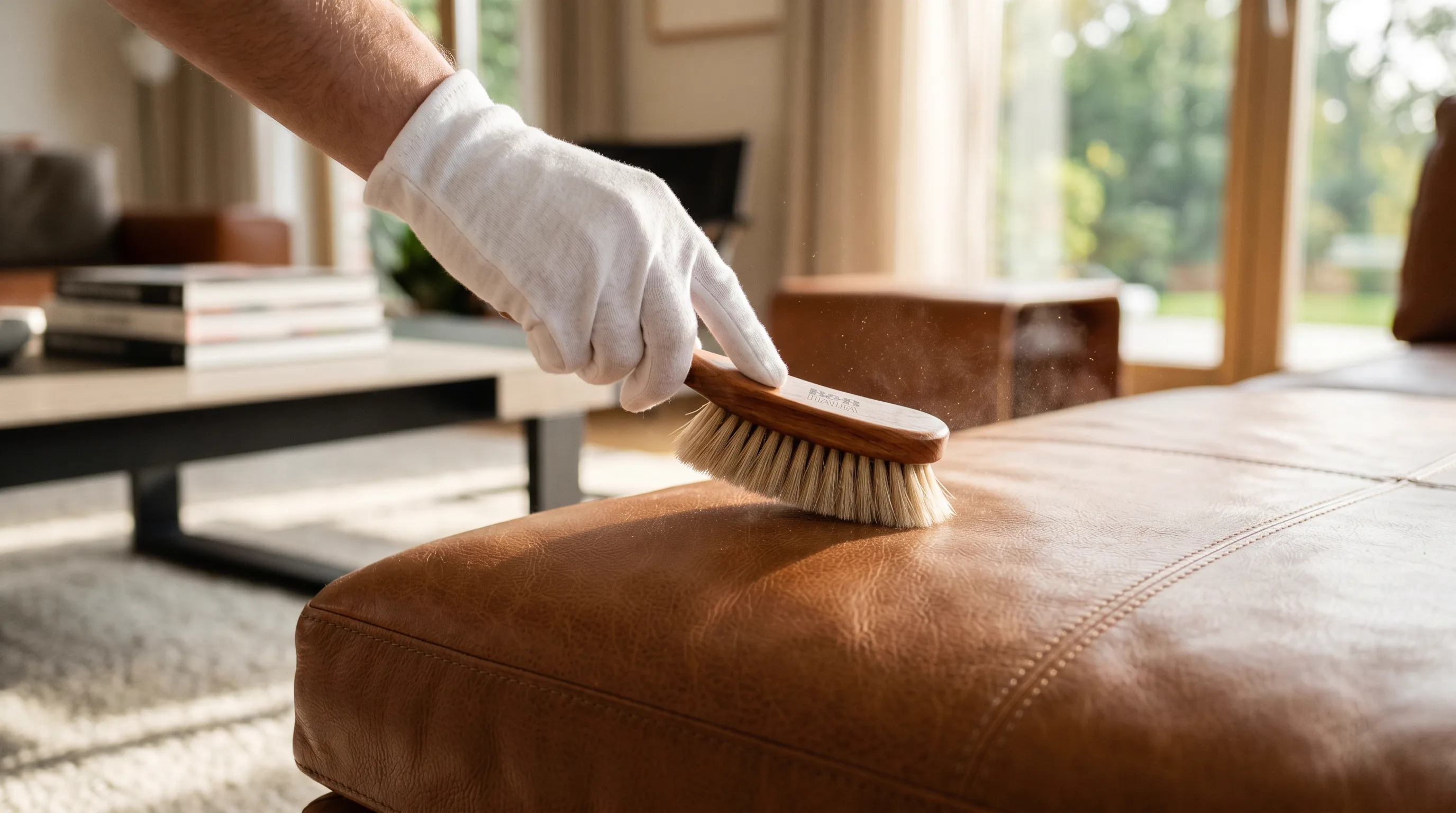
- Dry-brush visible surface mould gently away from the leather with a soft brush. Collect in a bin.
- Apply a pH-balanced antifungal leather cleaner to all surfaces, including seams and crevices. Work in small sections.
- Allow to dry fully with airflow - at least four to six hours.
- Place activated charcoal pouches behind the cushions to absorb residual moisture. Replace monthly through monsoon.
- Condition after the leather has dried completely to restore moisture that was stripped during the antifungal cleaning.
Fixing Body Oil and Sweat Smell
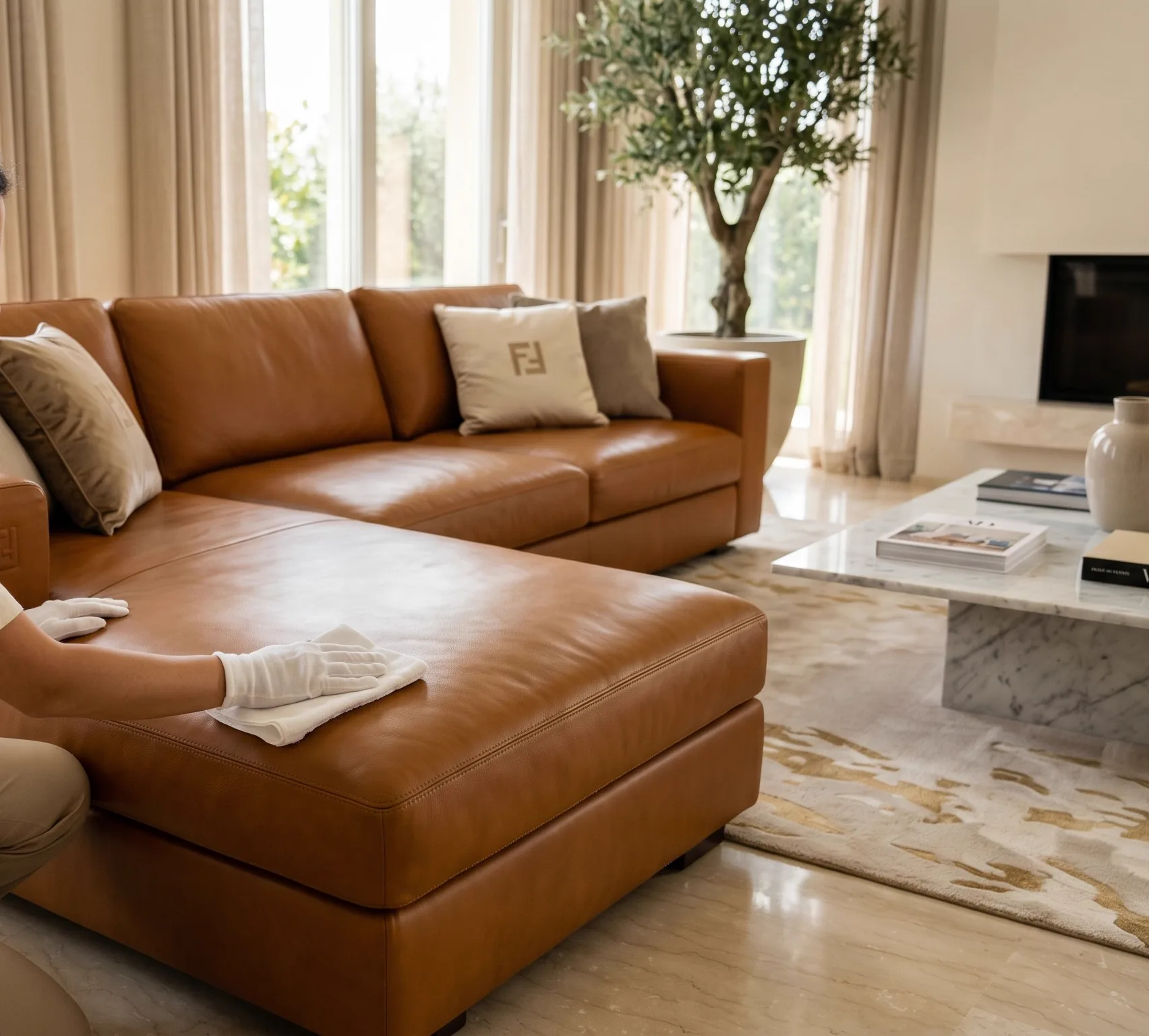
- Clean the armrests and seat top with a pH-balanced leather cleaner on a white microfibre cloth. Work in sections, not in one sweeping pass.
- If the odour is significant, a leather enzyme cleaner breaks down the organic compounds that regular cleaners leave behind.
- Allow to dry fully, then condition.
- Going forward: wipe armrests and seat top fortnightly with a barely damp cloth. This single habit prevents the problem from rebuilding.
Fixing Food Spill Smell
Surface cleaning handles the leather layer. The issue is usually the foam beneath. Apply an enzyme-based leather cleaner generously to the spill zone and allow it to penetrate for ten minutes before wiping. The enzymes break down the organic food compounds at a molecular level. For deep penetration into foam from a large oil spill - ghee or coconut oil from cooking - professional extraction is more effective than any home treatment.
Fixing Pet Urine Smell
Do not use water first. Moisture reactivates the uric acid crystals and releases the smell more strongly. Apply an enzyme-based pet odour neutraliser to the affected zone. Let it sit for 15-20 minutes. The enzymes break down the uric acid crystals, permanently eliminating the odour source rather than masking it. Wipe away, allow to dry, condition. Our dedicated leather sofa odour removal service uses professional-grade extraction for deep foam penetration.
Fixing Rancid Oil Smell
This requires thorough cleaning of every surface where oil was applied. A pH-balanced leather degreaser removes oxidised oil residue that a regular cleaner cannot. Two to three cleaning passes may be needed. After removing the rancid oil, condition with a professional-grade product to replace the lost surface protection.
"The mistake people make with leather sofa smell is reaching for the air freshener. That masks the odour for two days. The actual source - mould spores, uric acid crystals, rancid oil - is still there and keeps producing the smell. You have to neutralise the source, not cover it." - Tyson, Lead Artisan, The Leather Restorators
How to Stop Leather Sofa Smell From Coming Back
Clearing the odour is only half the job. In India the same conditions that caused it - heat, humidity, and daily skin contact - are still there, so a simple routine keeps the smell from rebuilding. The single biggest lever is humidity. Keep the room's relative humidity in the 40-55% range. Through the monsoon that usually means running the air conditioner on dry mode or a dehumidifier for a few hours a day, because once indoor RH climbs past 70% the leather's pores start holding moisture and mould has everything it needs to return.
The second habit is mechanical: wipe the armrests and seat top fortnightly with a barely damp cloth to lift body oil and sweat before they break down and turn sour. Clearing that film early is far easier than degreasing it after it has soaked in. Pair this with good airflow - air the room regularly and do not push the sofa flat against an outer or damp wall, where trapped, still air behind the back panel lets condensation and mustiness build unseen. Leave a few centimetres of gap so the back can breathe.
Finally, deal with accidents the moment they happen. Blot spills immediately rather than letting chai, ghee, or pet urine settle into the foam, where odour becomes a foam problem instead of a surface one. And condition seasonally, roughly every three to four months, so the topcoat stays sealed; an intact finish resists soaking up airborne odours and the next round of monsoon damp far better than dry, open leather does.
TLR EXPERT TIP: A small hygrometer (Rs. 300-600 at most hardware shops) on the side table near the sofa turns prevention from guesswork into a number you can act on. If the reading sits above 60% RH for days during monsoon, run the AC dry mode or dehumidifier before you ever smell anything - that is the window in which mould takes hold.
What Is Ozone Treatment, and When Is It Used?
Ozone treatment comes up in the context of monsoon mould and pet odour, so it is worth explaining plainly. A technician places the sofa in an enclosed space - a sealed room or a tented enclosure - alongside an ozone generator. The machine produces ozone (O3), a reactive form of oxygen that spreads through the air and oxidises odour molecules at their source. Because it is a gas, it reaches into the leather's pores, the seams, and the foam beneath - places a surface wipe simply cannot get to. That is why it works on the stubborn cases: deep monsoon mould, embedded cigarette smoke, and pet-urine odour that has soaked below the hide.
Two things make this a professional-only step, never a DIY one. First, ozone is harmful to breathe - it irritates the lungs and is not safe to be around at treatment concentrations. The room must be fully vacated while the generator runs and then aired out thoroughly before anyone re-enters, which is exactly the controlled handling a trained technician provides. Second, the dose and exposure time need to match the leather and the severity of the odour; too aggressive a treatment can stress an aged finish.
In practice, ozone is not the first move. We reach for it when enzyme cleaning and antifungal treatment alone have not fully cleared the odour - typically severe monsoon mould that has set into the foam, or pet-urine smell that keeps returning after surface neutralisation. For most leather sofa smells, the enzyme and antifungal routine described above is enough; ozone is the reserve option for the deep-set cases.
Frequently Asked Questions
Why does my leather sofa smell after monsoon?
Monsoon humidity creates conditions for mould and bacteria to grow inside the leather's pore structure. The musty smell that appears after monsoon is mould spores and bacterial metabolites trapped in the hide. Surface cleaning removes visible growth but not the embedded odour source. Ozone treatment or professional enzyme cleaner is needed to neutralise it fully.
How do I get rid of pet smell from a leather sofa?
Pet odour from urine penetrates through the leather into the foam below. Surface cleaning alone does not reach it. The effective approach is enzymatic cleaner applied to the affected zone, followed by a leather deodoriser. For deep urine penetration into foam, professional extraction and odour neutralisation is required.
Is it safe to use baking soda on a leather sofa for smell?
Baking soda placed in a bowl near the sofa to absorb ambient odour is safe. Applying baking soda directly to leather is not recommended - it is mildly alkaline and disrupts the natural pH of leather, leading to dye fade and surface dryness over time. Use it as an ambient absorber, not a direct application.
My new leather sofa has a strong chemical smell - is that normal?
Yes. New leather sofas carry residual tanning chemicals, finishing agents, and adhesives from manufacturing. This smell typically fades within four to eight weeks with good ventilation. Air the sofa in a well-ventilated room with windows open for the first two weeks. Do not apply any deodoriser to a new sofa - it can react with the uncured finishing chemicals.