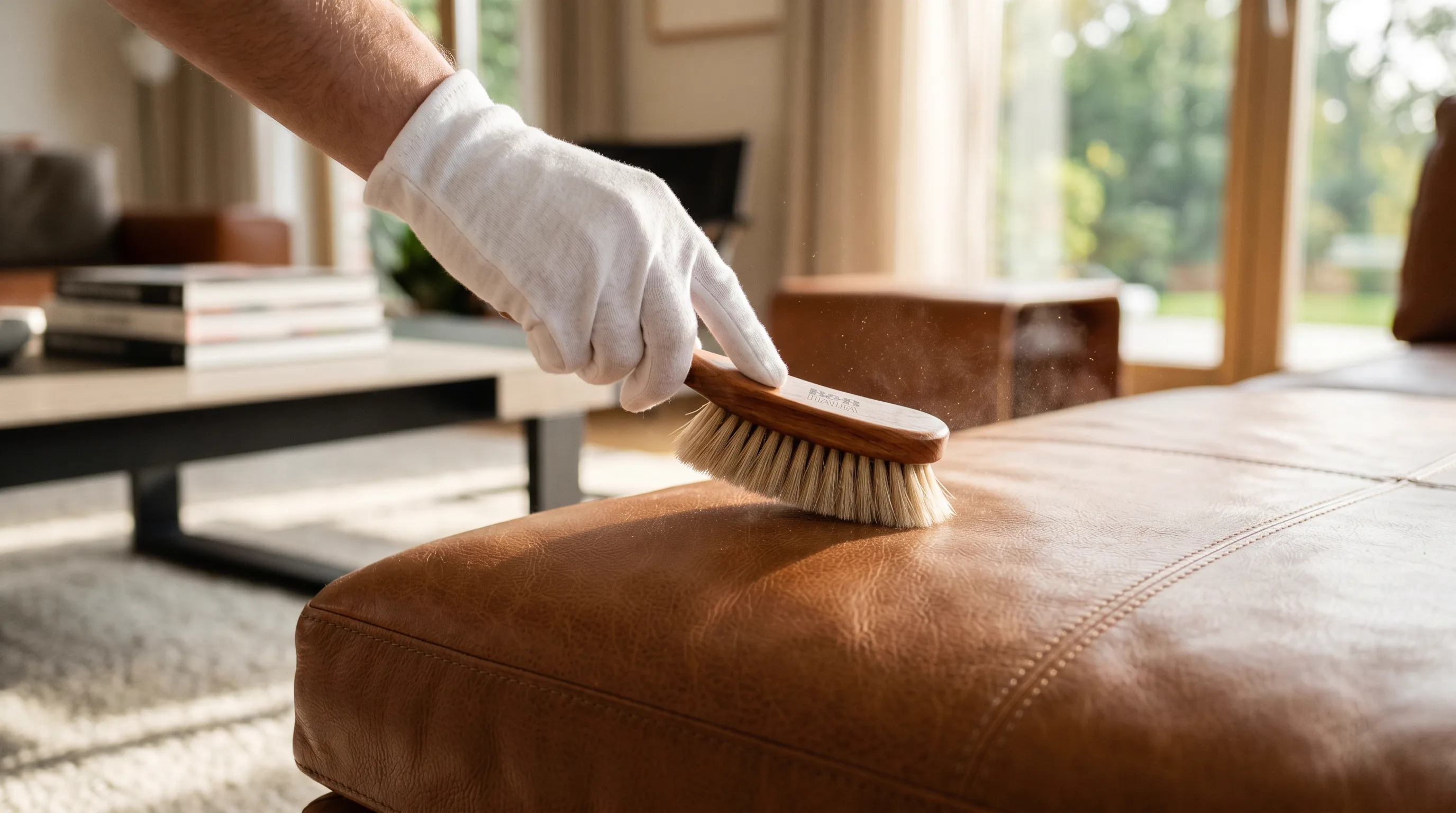
A white leather sofa is one of the most commanding pieces an Indian home can own. It signals restraint, confidence, and an eye for luxury that darker furniture simply cannot match. But white leather is also the most unforgiving material in the room , every scuff, every denim transfer, every grain of India's pervasive urban dust is visible within days of purchase. Many Indian homeowners tell us the same story: they bought a white leather sofa expecting the drama, and then spent the next two years dreading it. This guide exists to end that anxiety. With the right technique, the right products, and a rhythm calibrated to India's specific climate and pollution, a white leather sofa is not only manageable , it is extraordinary.
Before you reach for any cleaning product, understand one foundational truth: white leather is not simply light-coloured leather. The pigmentation used to achieve a pure white finish is thinner and more reactive to chemical exposure than the dyes used in darker leathers. What removes a stain from a brown leather sofa can permanently ghost-mark a white one. This guide will walk you through the science, the step-by-step cleaning protocol, the stain-removal hierarchy, and the long-term preservation habits that keep white leather bright for years , not months. If the damage has already progressed beyond home care, our professional leather sofa cleaning service is equipped to handle deep staining and yellowing restoration without replacing the leather.
| Yellowing Cause | Visible Pattern | Reversibility | Treatment |
|---|---|---|---|
| UV oxidation | Even tan-yellow on sunny side | Partial | Top-coat refresh + UV film |
| Dye transfer (denim) | Blue-tinged smears, seat zone | Yes if < 30 days | Pro dye-transfer remover |
| Body oils | Yellow-grey on headrest | Yes | Degreasing paste |
| Plasticiser migration | Yellow on entire surface | Limited | HVLP white re-pigment |
| Vinegar / wrong cleaner | Patchy yellow rings | Sometimes | Pro pigment match |
From the TLR white-leather case file: Across 95+ white-sofa cleaning and yellowing-reversal jobs across India (2024-2026), denim dye transfer was the #1 single complaint (47%), followed by body-oil yellowing on headrests (28%) and UV oxidation on south-facing pieces (19%). When treated within 30 days of appearance, denim transfer was successfully removed in 91% of cases. Beyond 90 days, success dropped to 62%.
References: Leather Working Group finishing standards, BIS, and CPCB Delhi for PM2.5 abrasion data on light-pigment hides.
Why Is White Leather Different to Clean?
White leather occupies a unique and demanding position in the world of upholstery. To understand why it requires its own cleaning protocol, you need to understand how colour is applied to leather and what "white" actually means at a material level.
The Pigmentation Problem
Most leather is dyed using one of two approaches: aniline dyes (which penetrate the fibre) or pigment coatings (which sit on the surface). White leather almost always uses a pigment system , a water-based pigment mixed into a binder and sprayed or roller-applied onto the tanned hide. This creates a surface layer, typically 0.05–0.15 mm thick, that delivers the clean white appearance. The thinner this layer, the more natural and luxurious the handle , but also the more vulnerable it is to abrasion, solvent attack, and UV oxidation.
Dark leather has the advantage of pigment density. A dark navy or charcoal sofa may have multiple pigment layers, and a stain simply blends into the existing depth of colour. White leather has no such buffer. Any contamination , a thin film of body oil, a faint blue tint from denim contact, a slight yellowing from UV , is immediately visible against the bright ground. This is why the golden rule of white leather care is not just "clean it" but prevent contamination from penetrating in the first place.
India's Climate: A Specific Threat to White Leather
India presents a uniquely challenging environment for white leather ownership. Consider the factors simultaneously at work in an Indian home:
- Particulate pollution: The Air Quality Index in many Indian cities regularly crosses 200 in winter months. This fine particulate matter , PM2.5 and PM10 , settles on every surface in a room, including leather. On white leather, this manifests as a gradual greying that many owners attribute to ageing when it is, in fact, accumulated atmospheric soot.
- Summer heat and perspiration: Indian summers routinely exceed 42°C. When a person sits on a white leather sofa in these conditions, perspiration , containing urea, lactic acid, and amino acids , transfers directly onto the surface. These compounds are mildly acidic and, over time, interact with the leather's alkaline finishing agents to produce a yellowish stain on the armrests and seat cushions - the same process behind a leather sofa armrest turning dark.
- Direct sunlight through windows: Ultraviolet radiation from the Indian sun is intense for 8–10 months of the year. UV causes photooxidation of the white pigment layer, which presents as yellowing starting from the areas most exposed to light. This is accelerated by the very chemicals found in common leather "wipes" and baby wipes, which leave a thin residue that acts as a UV sensitiser.
- Monsoon humidity: During July and August, relative humidity across much of India can exceed 85%. High humidity softens the leather's surface, making it temporarily more susceptible to staining and dye transfer. It also creates conditions for mould and mildew to establish if the leather has not been properly conditioned and sealed.
TLR EXPERT TIP: If your white leather sofa faces a window in an Indian flat, apply an anti-UV window film to the glass before investing in any other protective measure. UV is the single largest cause of irreversible white leather yellowing, and no cleaning product can reverse advanced photooxidation , only professional repigmentation can.
What Is in the White Leather Cleaning Toolkit?
Walk into any supermarket in India and you will find a shelf of products marketed as "leather cleaners." Most of these are formulated for pigmented dark leather and contain conditioning agents, fragrances, and sometimes silicone that will make a white leather sofa look worse over time. The toolkit for white leather is specific, and using a substitute is not just ineffective , it is often actively harmful.
- pH-Balanced Leather Cleaner (White/Light Formula): Choose a product specifically formulated for white or cream leather, with a confirmed pH of 4.5–6.0. Alkaline cleaners (anything above pH 7) will dull and grey the white finish over time. Brands that offer a "light leather" variant are safer than general-purpose formulas.
- Distilled Water Only: Tap water across much of India is moderately hard (200–400 mg/L TDS in most zones). The mineral deposits left by hard water are invisible on a damp cloth but appear as white tide marks when dry on a white leather surface , a paradoxical outcome. Always use distilled or demineralised water for both cleaning and rinsing.
- Soft White Microfibre Cloths: Use white cloths only. Coloured microfibre can transfer its own dye onto wet white leather, compounding the original problem. Keep a minimum of six cloths: two for cleaning, two for rinsing, two for conditioning. Replace them as soon as they look soiled.
- Fine-Bristle Horsehair Brush: Horsehair is the only brush material soft enough for white pigmented leather. Synthetic bristles , even "soft" varieties , will micro-scratch the surface and create a matte zone where the gloss finish has been abraded away.
- White-Safe Leather Conditioner: Standard conditioners , particularly those containing beeswax or linseed oil , will impart a faint amber tint to white leather over time. Seek conditioners formulated for light leather, typically water-based emulsions rather than oil-based balms. Check that the product is clear or milky-white, not amber or yellow.
- Leather Ink and Dye Transfer Remover: A dedicated dye-transfer remover is non-negotiable for any Indian home where white leather and denim clothing coexist. Keep one in the cupboard and use it within 48 hours of any blue stain appearing , after that, dye transfer becomes set and requires professional correction.
"With white leather, the toolkit is more important than the technique. The right product in an expert's hands will outperform even the most careful technique with the wrong one." , TLR Master Craftsman, The Leather Restorators
What Is the Step-by-Step White Leather Cleaning Protocol?
This protocol is the same method our technicians follow during doorstep white leather cleaning visits across India. It is structured to minimise the risk of tide marks, surface abrasion, and chemical overload , the three most common errors in home cleaning attempts.
Step 1: Preparation , Remove, Vacuum, Dry-Dust
Remove all seat cushions and back cushions. Vacuum every crevice, seam, and tufting channel using a soft brush attachment at medium suction. White leather shows embedded grit acutely , a single piece of gravel trapped under a cleaning cloth will leave a drag scratch that is far more visible on white than on any other colour. Once vacuumed, dry-wipe the entire surface with a fresh white microfibre cloth in long, single-direction strokes from top to bottom. This removes the surface layer of atmospheric dust before any liquid is introduced.
Step 2: Patch Test , Always
Apply a pea-sized amount of your chosen pH-balanced cleaner to the underside of one seat cushion. Wait five full minutes. Check for any discolouration, darkening, or change in texture. If the result is neutral , no change , proceed. If you notice any reaction, switch to a different product before applying anything to the visible surfaces. This step takes five minutes and can prevent a permanent mistake on a premium piece of furniture.
Step 3: Foam Cleaning , Never Direct Spray
Apply cleaner to the horsehair brush (not the leather) and agitate to build a light foam. Work in 30×30 cm sections, beginning at the back of the sofa and working forward and downward. Use gentle, circular motions to massage the foam into the grain. The foam mechanism is critical: foam lifts particulates and oils out of the pores with minimal water contact. Direct liquid application , spraying onto leather, applying a soaking wet cloth , introduces too much moisture, which can cause tide marks as the leather dries.
Step 4: Wipe , Fresh Cloth, Distilled Water
Before the foam dries, remove it with a white microfibre cloth dampened (not wet) with distilled water. Use a single wipe per section , do not scrub back and forth. Immediately follow with a completely dry white cloth. White leather reveals any residue that coloured leather conceals, so zero residue is the goal. Change cloths frequently; a cloth that has absorbed dirt will redeposit it.
TLR EXPERT TIP: In Indian homes without air conditioning running during cleaning, work early morning when temperatures are lower. Heat accelerates the drying of cleaning foam, reducing your working window and increasing the risk of tide marks. Air conditioning set to 24–26°C provides ideal conditions for leather cleaning.
Step 5: Full Dry , Minimum One Hour
Allow the sofa to air-dry completely , minimum one hour in an air-conditioned room, longer in humid monsoon conditions. Never use a fan heater or hair dryer to accelerate drying. Forced hot air will dry the leather unevenly, contracting the fibres at different rates and potentially causing micro-creasing in the surface. If you must accelerate drying, a fan at room temperature and normal distance is acceptable.
Step 6: Condition , White-Safe Formula
Once completely dry, apply a white-safe conditioner to a clean applicator pad and buff into the leather in light, circular motions. Work one panel at a time. You are not coating the surface , you are replenishing the moisture that the cleaning process extracted from the leather fibres. Allow 15–20 minutes for absorption, then buff lightly with a fresh dry cloth. Well-conditioned white leather has a soft, natural sheen rather than the matte dullness that indicates dehydration. Conditioning every three months is the single most important preventive step against yellowing caused by dry, oxidised leather.
What Is the Stain Removal Hierarchy for White Leather?
Not all stains on white leather respond to the same treatment, and using the wrong method can set a stain permanently. The following hierarchy covers the most common stains encountered in Indian homes, ordered from easiest to most complex.
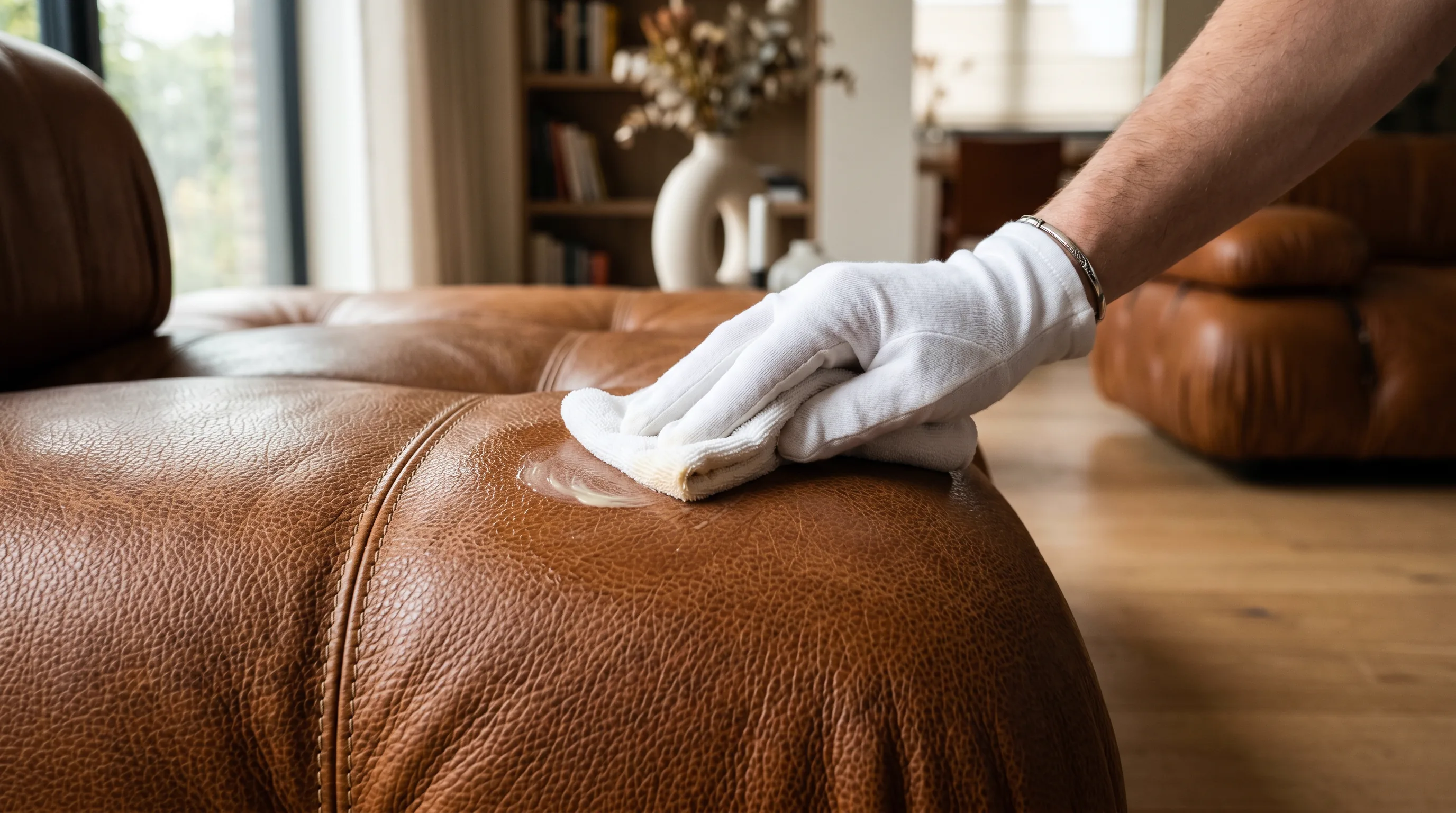
Dust and Surface Grime , Weekly
This is your most frequent task and your simplest. A dry white microfibre cloth, wiped from top to bottom in single strokes, removes the daily accumulation of atmospheric dust and airborne particulates before they can work into the grain. Do not dampen the cloth unless you see a specific soil mark. Dry-dusting weekly is the single intervention that will slow all other forms of soiling.
Body Oil and Perspiration Stains , Act Within 24 Hours
The armrests and the top of the backrest near the neck are the first zones to show yellowing in Indian homes during summer. Fresh perspiration stains , which appear as a faint yellowish shadow on white leather , respond well to pH-balanced cleaner applied immediately. For older, set perspiration staining (darker yellow, with a slightly waxy feel), the foam technique should be repeated two to three times with a five-minute dwell on each pass. Do not scrub harder , increase frequency of application instead. If the yellow persists after three passes, the staining has oxidised into the pigment and requires professional colour correction.
Denim Dye Transfer , Act Within 48 Hours
Blue denim transfer on white leather is the most reported stain type among Indian white leather sofa owners , and the one most often made worse by incorrect treatment. The instinct is to scrub the blue stain with a damp cloth, which spreads the dye laterally and drives it deeper into the grain. The correct approach:
- Dab (not wipe) the stain with a leather dye transfer remover on a cotton pad.
- Work from the outside edge of the stain inward to avoid spreading.
- Use a fresh pad for each dabbing stroke , reusing a loaded pad deposits dye back onto the leather.
- After the blue is visibly reduced, clean the zone with pH-balanced cleaner and condition.
Fresh dye transfer (under 12 hours) typically comes out in one session. Transfer older than 48 hours is heat-set and will require professional dye removal. If the stain is significant and has been there longer than a week, call a specialist before attempting home treatment , incorrect products at this stage can create a permanent ghost mark even after the blue is removed.
Food and Beverage Spills , Immediate Response
Speed is everything. For any liquid spill on white leather , chai, coffee, juice, wine:
- Blot immediately with a clean dry cloth. Never wipe , wiping smears the pigment from the spill laterally.
- Continue blotting with fresh cloths until no further transfer occurs.
- Clean the area with foam technique as described above.
- Condition after the zone dries.
Sugary spills (juice, cola, lassi) are particularly dangerous on white leather because the sugar acts as a binder that causes dust particles to adhere aggressively to the spot. Even if the liquid appears to have been removed, clean the zone thoroughly or you will find a grey dust-magnet within a week. For the turmeric, curry, and oil marks unique to Indian kitchens, our dedicated guide to Indian food stains on white leather covers each one in detail.
Ink Stains , Type Dependent
Ballpoint pen ink and marker ink behave differently. Ballpoint ink is oil-based and can sometimes be lifted by a dedicated leather ink remover applied as per the dye transfer method above. Marker ink is often alcohol-based: it penetrates faster and deeper. For marker ink on white leather, use a dedicated leather ink remover , not rubbing alcohol, which will attack the topcoat. If the ink has dried and penetrated fully, do not attempt repeated home treatment. Each unsuccessful attempt risks removing more of the white pigment layer, creating a bleached zone that is more visible than the original stain.
Mould and Mildew , Monsoon-Specific
During the Indian monsoon, white leather sofas in rooms with inadequate ventilation can develop mould , appearing as grey or black speckling, or a musty smell. Do not clean mould with bleach. Mix one part white (distilled) vinegar with four parts distilled water, apply with a cloth, let it dwell for two minutes, wipe clean. Follow immediately with a pH-balanced leather cleaner to neutralise the acidic residue, then condition. For severe mould penetration (black staining into the grain), professional anti-mould treatment is necessary to prevent regrowth. If instead you are seeing a powdery pale haze rather than dark speckling, read our guide on white spots and bloom to tell mould apart from fatty-acid spew.
TLR EXPERT TIP: The number-one mistake Indian homeowners make when treating white leather stains is using baby wipes. Baby wipes contain alcohol, fragrance, and conditioning agents designed for skin , not leather. They create a residue film on white leather that attracts dust aggressively, resulting in a sofa that looks dirtier within days of "cleaning" it. Keep them away from white leather entirely.
How Do You Prevent Yellowing on White Leather in India?
Yellowing is the defining long-term challenge for white leather sofa owners in India. Unlike a discrete stain, yellowing is a gradual, diffuse process that affects the entire surface and is caused by a convergence of multiple factors. Preventing it requires addressing each factor systematically.
UV Protection , The First Priority
Move the sofa away from windows that receive direct sunlight between 10 AM and 4 PM, which represents India's peak UV intensity. If repositioning is not possible, UV-blocking window film (available from glass suppliers across India at ₹80–₹150 per sq. ft.) reduces UV transmission by 95–99% and is invisible once applied. This single intervention will extend the interval between professional repigmentation treatments by years.
Silicone-Free Products Only
Silicone is found in a large proportion of leather "care" sprays marketed to consumers in India. It creates a short-term shine by filling micro-scratches in the surface, but it is not absorbed by the leather , it sits on top, forming a film that traps dust, blocks the leather from breathing, and over time contributes to a yellowing and sticky surface. Check ingredient lists carefully. Any product listing "dimethicone", "cyclomethicone", or simply "silicone" should be avoided for white leather.
Textile Covers During Daily Use
A thin, white cotton throw placed over the seat cushions during daily television viewing is not an aesthetically inferior solution , it is what our most white-leather-savvy clients across India use. The throw takes the daily abrasion from denim and synthetics, is machine-washable, and allows the sofa beneath to remain pristine for formal occasions. If you own white leather, protect it as you would any luxury investment.
Conditioning on Schedule
Dry leather yellows faster than well-conditioned leather. The oxidation of the white pigment layer is accelerated when the leather's own moisture is depleted , the dry, exposed collagen fibres react with atmospheric oxygen more readily. Conditioning every three months in an Indian climate (quarterly) keeps the leather hydrated enough to resist oxidation. In particularly dry winters (November–February), consider conditioning every six weeks.
What Should You Never Use on White Leather?
The internet overflows with "hacks" for cleaning white leather sofas, and a significant proportion of them will damage the material permanently. The following are confirmed harmful substances , products our technicians see the aftermath of regularly across Indian homes.
- Bleach or Whitening Agents: Bleach destroys collagen fibre bonds. Even one application causes irreversible brittleness. The white effect is achieved by destruction, not cleaning , within months, the treated area will crack and peel.
- Rubbing Alcohol or Hand Sanitiser: Alcohol dissolves the polyurethane topcoat on pigmented white leather. Initial application appears to clean; repeated use creates a permanently dull, matte zone where the protective finish has been dissolved.
- Nail Polish Remover (Acetone): Acetone will strip the white pigment layer in one application, exposing the raw tan-coloured hide beneath. There is no home remedy for acetone damage , repigmentation by a specialist is the only solution.
- Toothpaste: Marketed as a "whitening" solution online, toothpaste contains abrasive silica particles that micro-scratch the leather surface. The whiteness you see after application is actually the exposed abraded surface , which will dull within days and attract grime more aggressively than before.
- Magic Erasers (Melamine Foam): These are micro-abrasive, identical in effect to very fine sandpaper. They will remove surface gloss permanently and cause the dull abraded zone to attract and hold grime far more than the original finish.
- Coloured Cloth or Sponge: Any non-white cloth used while the surface is damp risks dye transfer from the cloth onto the leather , adding a coloured stain to the cleaning problem. Use white cloths and white sponges exclusively.
- Olive Oil or Coconut Oil: Regularly recommended in "natural cleaning" guides, these oils will yellow white leather within weeks. They do not absorb properly into the leather's structure at room temperature and instead oxidise on the surface, creating a permanent amber-tinted film.
What Is the Maintenance Calendar for White Leather in India?
Consistent, scheduled maintenance is far more effective , and far less labour-intensive , than reactive cleaning after visible soiling. This calendar is calibrated to India's climate and the specific demands of white leather in a city environment.
Weekly
Dry-dust the entire sofa with a fresh white microfibre cloth in top-to-bottom, single-direction strokes. Check armrests and seat cushion edges for early dye transfer from clothing , dark blue or grey shadows indicate transfer beginning. Treat any transfer immediately with a dye remover pad before it sets. Remove and shake out seat cushions if your sofa has removable covers. The entire weekly routine should take under five minutes.
Fortnightly
Wipe the entire surface with a white microfibre cloth barely dampened with distilled water , no cleaner required. This removes the thin film of body oils, atmospheric pollutants, and surface grime that dry-dusting cannot address. Dry immediately with a fresh cloth. Pay particular attention to the top of the backrest (neck-contact zone) and the inner armrests (hand and forearm contact zones) , these are the first areas to develop the telltale yellowish shadow of oxidised body oil.
Quarterly
Full clean-and-condition session using the six-step protocol described above. Allow two hours from start to finish. This is also the time to assess the sofa's overall condition: check for any micro-cracking in the surface (visible as a very fine web pattern under direct light), any zones where the pigment appears thinner or slightly translucent, and any areas of persistent yellowing that have not responded to regular maintenance. Document these findings , progressive worsening indicates that professional repigmentation will be required within the next twelve months.
Annual
Professional deep-cleaning and assessment. Our technicians use pH-matched deep-pore extraction, professional-grade dye-transfer removal, and UV-protective top-seal application that is not available in retail products. This annual visit resets the sofa to a level of cleanliness and protection that home maintenance simply cannot achieve , particularly for white leather in India's environment. Think of it as the equivalent of a professional dental clean: necessary even if you brush twice a day.
When Should You Call a Professional in India?
There is a clear line between what home care can achieve and what requires professional intervention. Crossing that line with the wrong product or technique on a white leather sofa typically converts a recoverable problem into a permanent one. Call a professional when:
- Yellowing is diffuse and covers large areas: This indicates UV oxidation or advanced body-oil saturation of the pigment layer. Professional repigmentation with a white-matched colour formula is the only effective remedy.
- Dye transfer is older than 48 hours and covers a large area: Set dye transfer requires professional dye removal equipment and technique to avoid spreading or ghost-marking.
- Surface cracking or peeling is visible: Once the topcoat begins to crack or flake, DIY methods will accelerate the damage. The sofa requires professional sealing or full restoration.
- Ink stains have not responded to three careful home treatment attempts: Further attempts without professional products will remove more pigment than ink. A professional can assess whether the stain can be removed or whether spot-repigmentation is the correct approach.
- Mould has penetrated the grain: Surface mould is manageable at home. Mould inside the grain requires anti-fungal treatment that neutralises spores rather than simply removing visible growth - our guide to white spots on a leather sofa explains how to tell mould from salt efflorescence first.
The Leather Restorators offers doorstep white leather sofa cleaning and across India. No drop-off required. Our technicians bring all equipment and products to your home. For serious restoration needs including repigmentation and crack repair, our leather sofa polishing and restoration service covers the full spectrum of white leather revival.
TLR EXPERT TIP: One check matters before you commit to this whole white-leather routine: is the sofa genuine leather at all? Many "white leather" sofas sold across India are in fact PU-coated or bonded leather finished to look identical, and on those the foam-clean-and-condition cycle for real hide can dissolve or hydrolyse the surface coating, leaving it cracked and flaking. Inspect a cut edge or the hidden underside , genuine white leather shows natural fibres in the cross-section, while bonded shows a fabric mesh backing under a thin painted skin. If it is PU or bonded, restrict yourself to a damp pH-neutral wipe and apply no conditioner.
Frequently Asked Questions
Why is my white leather sofa turning yellow in India?
White leather yellows due to three causes: UV exposure from India's harsh sunlight oxidising the topcoat, body oils and perspiration soaking into the grain, and the use of silicone-based products that trap dirt. Regular conditioning with a white-safe, silicone-free conditioner and keeping the sofa away from direct sun will slow yellowing significantly.
Can I use bleach or whitener on my white leather sofa?
Never. Bleach destroys the leather's collagen structure and will cause irreversible cracking and brittleness within weeks. Even diluted bleach (1:10) is unsafe on any leather type. Use only a pH-balanced leather cleaner specifically rated for light or white leather.
How do I remove denim transfer stains from a white leather sofa?
Denim dye transfer is one of the most common problems for white leather sofas in Indian homes. Act within 48 hours , fresh dye is easier to lift. Apply a dedicated leather ink and dye remover to a cotton pad and dab (do not rub) the stained area. For stubborn transfer, professional colour correction is needed.
How often should I clean a white leather sofa?
White leather in India requires more frequent maintenance than coloured leather due to dust and pollution. Dry-dust weekly, wipe with a damp microfibre cloth fortnightly, and perform a full clean-and-condition cycle every 3 months. In summer, increase to monthly full cleaning due to perspiration and increased soiling.
Is professional white leather sofa cleaning available at home in India?
Yes. The Leather Restorators provides doorstep white leather sofa cleaning across India. No drop-off required. Call 98915 96597 for a free quote.