If your sofa is peeling and the showroom called it leather, you are not alone , and you are probably not dealing with real leather. Four different materials get sold as "leather" in Indian retail: real leather, bicast leather, bonded leather, and pure polyurethane (PU) or PVC. Only one of them is actually leather in any chemical sense. The other three are plastic films, plastic composites, or plastic textiles wearing leather's name. By the time a buyer notices the seat front flaking apart at two years, the diagnosis is too late to help. This guide tells you what each category really is, how to tell them apart using five tests you can run at any showroom, what service life to expect from each, and what restoration is actually possible once failure starts. Technical terms are defined in the leather conservation glossary. The structural background on what real leather means is in the grain hierarchy guide.
What Are the Four Types Sold as Leather?
Marketing labels blur the differences on purpose. The chemistry does not. Here is what each category actually is.
Real leather is the chrome-tanned or vegetable-tanned hide of a bovine, ovine, or caprine animal. It is a fibrous protein structure transformed through tanning chemistry , documented in the tanning chemistry guide. The structural and visible material is the natural hide. Real leather divides into the grain types of full-grain, top-grain, and corrected-grain and the finish types of aniline, semi-aniline, and pigmented. All real leather absorbs water, develops patina, smells organic, and shows a fibrous structure at any cut edge.
Bicast leather is a hybrid. The backing is split leather , the weakest layer of a real hide left over after the grain layer has been removed for higher-value top-grain products. A polyurethane film, typically 0.1 to 0.3 millimetres thick, is laminated onto the split. The surface you see and touch is the polyurethane. The leather underneath provides backing but you never contact it. The grain pattern on the surface is embossed into the plastic film.
Bonded leather is a composite. Leather scraps, shavings, and tannery waste are ground into pulp and mixed with a polyurethane binder. The slurry is spread onto a fabric backing, dried, and embossed with a fake grain pattern. Total leather content is typically 10 to 20 percent by weight. The rest is polyurethane binder and fabric backing. There is no continuous leather structure anywhere in the material , only suspended particles in a plastic matrix.
PU and PVC "leather" contain zero leather. PU leather is a polyurethane film bonded to a woven fabric backing. PVC leather is a polyvinyl chloride film on the same type of backing. The word "leather" in both names refers only to the look the synthetic film imitates. Both are textile products. They belong in the same category as upholstery vinyl and synthetic seat coverings , not in the leather category at all.
The chemistry rule: only real leather has a continuous natural hide structure. Bicast has a hidden split layer under a plastic surface. Bonded has scattered leather particles in a plastic matrix. PU and PVC have no leather at all. In three of the four categories, the surface you touch every day is plastic , and plastic films age far faster than real leather does.
Why Does Bicast Leather Crack After a Few Years?
The shoe industry invented bicast in the 1960s as a low-cost alternative to patent leather. Furniture manufacturers started using it in the 1990s when they discovered it looked convincingly like pigmented leather under showroom lighting. The structural problem was understood from the start. The marketing solved it by not mentioning the failure mode.
Why bicast cracks
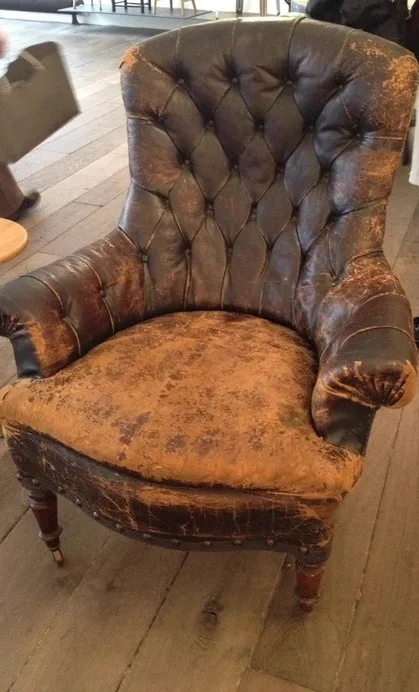
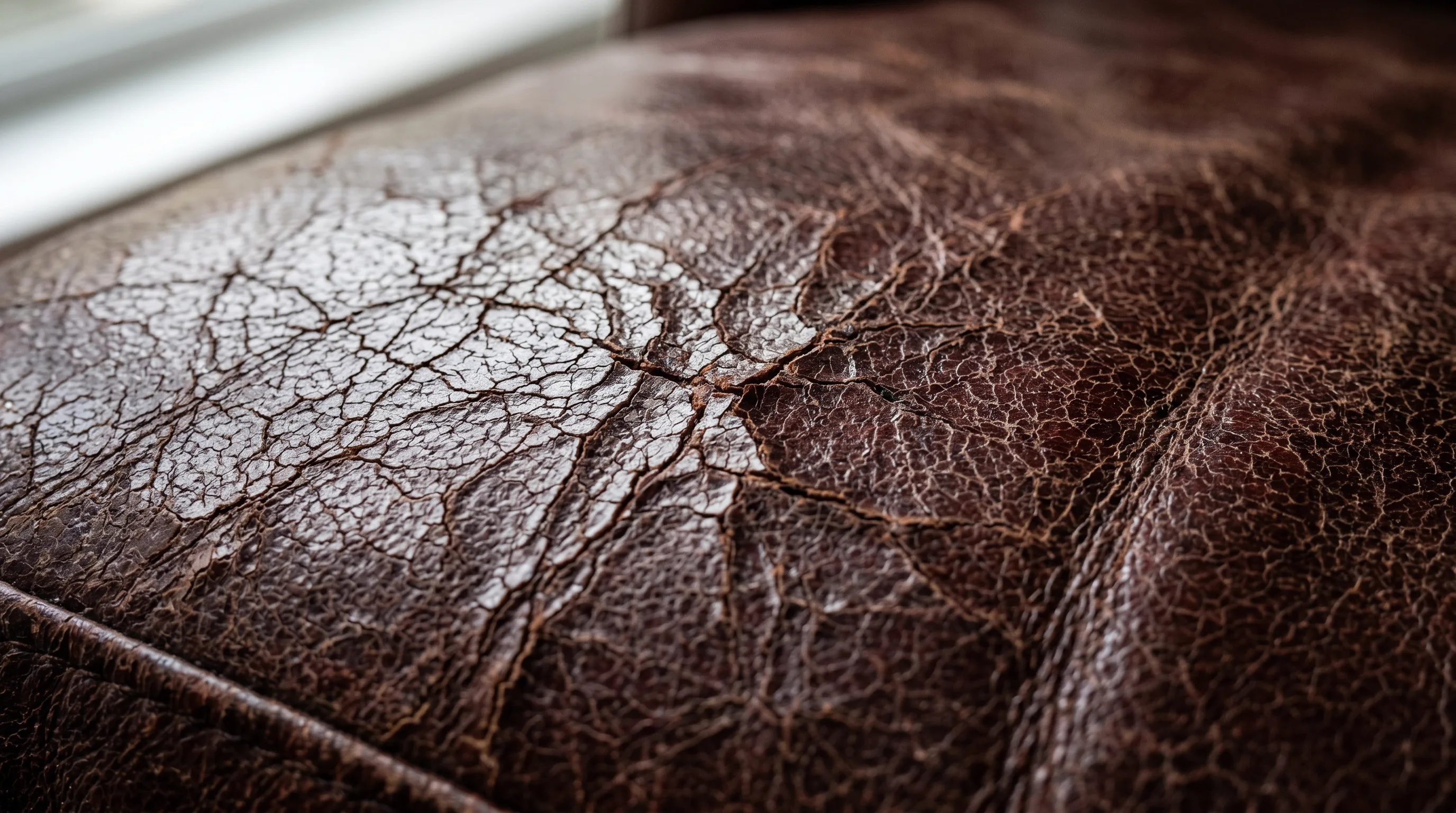
The polyurethane film and the leather backing beneath it flex in fundamentally different ways. Real leather flexes through fibre rearrangement , the natural fibres slide past each other and return to position when the load releases. The polyurethane film flexes by stretching the polymer [polymer: a long chain molecule; here, the plastic film] chains. With repeated cycles, those chains develop microscopic fractures that grow over time. After three to five years of normal seating use, the fractures reach the surface as a network of fine cracks at the highest-flex zones , the seat front, armrest tops, and the back panel where shoulders rest. Once cracks reach the surface, water and dirt penetrate to the leather backing and the failure accelerates.
Where bicast hides in the Indian retail market
Bicast appears in mid-tier furniture priced between forty thousand and one lakh rupees , the range where sellers want a leather-looking product at a price real leather cannot match. Common label terms that signal bicast: "split leather," "leather match," "coated leather," "bicast leather," and , most deceptively , "genuine leather" used loosely to mean the product contains some real leather somewhere in its construction. The deception works because the buyer assumes "genuine leather" means a continuous real-leather surface. The seller's lawyers can defend the term because the hidden split backing technically is genuine leather. Restoration options for failed bicast are covered later in this guide. The short answer is they are very limited.
Why Does Bonded Leather Peel and Fall Apart?
Bonded leather is the worst-performing material routinely sold as leather anywhere in the world. The claim on the label , that it contains real leather , is technically true and structurally meaningless. The 10 to 20 percent leather content consists of ground particles suspended in a polyurethane matrix that does all the actual structural work. When the polyurethane fails, the leather particles do nothing to slow it down. They have no structural role.
Why bonded leather peels
Polyurethane binder hydrolyses [hydrolyses: breaks down chemically when it absorbs moisture] , the polymer chains break apart through a moisture-driven reaction. All polyurethane hydrolyses eventually. The rate depends on humidity, temperature cycling, UV exposure, and the specific formulation used. In India's monsoon-and-dry-cycle climate, bonded leather hydrolyses fast. The first sign is usually a crackle pattern in the surface coating at high-contact zones. Within months, the surface starts lifting and peeling as the binder loses cohesion. Once peeling starts, the panel falls apart progressively. Not from a single catastrophic failure , from the cumulative loss of binder integrity across the whole panel.
Where bonded leather hides
Bonded leather appears in budget furniture priced between fifteen thousand and forty thousand rupees, in office chairs marketed as "executive leather," in headboards and ottomans where surface stress is moderate, and in commercial hospitality furniture replaced on three-year cycles. Common label terms: "bonded leather," "reconstituted leather," "blended leather," "leather composite," and , again , the deceptive use of "genuine leather" or "real leather" for a product whose visible surface is plastic with leather particles in it. Indian e-commerce listings frequently call these sofas "leather sofa" with no qualifier. Honest disclosure usually only appears deep in the product specifications, if at all. The distinction between bonded and real leather repair work is documented in leather sofa repair. Bonded leather typically falls outside the scope of any meaningful restoration.
Is PU Leather Real Leather? No , Here Is What It Actually Is
PU leather and PVC leather contain no leather. That is the one clear fact. The dishonesty is in the name. Calling a polyurethane-coated polyester textile "PU leather" rather than "polyurethane upholstery" is a marketing convention so widespread that the global furniture trade has stopped questioning it. Buyers end up genuinely believing they bought a leather product when they bought a synthetic textile.
PU leather is a polyurethane film coated onto a woven polyester or cotton-polyester backing. The film is embossed with a grain pattern, pigmented to leather-like colours, and finished with a top-coat that imitates the surface of pigmented real leather. As a textile it performs reasonably , stain-resistant, easy to wipe, available in any colour, much cheaper than real leather. It also hydrolyses over time like any polyurethane. In Delhi NCR, service life is typically four to seven years before visible surface degradation begins.
PVC leather is older technology , polyvinyl chloride film on the same fabric backings. PVC resists hydrolysis better than PU but feels more plastic-like under your fingertip. It also emits the characteristic plasticiser smell that anyone who has bought a new car interior will recognise. PVC is steadily being replaced by PU in furniture because the surface feel of PU is closer to real leather , even though PVC outlasts it.
Where PU and PVC show up. Budget sofas under fifteen thousand rupees are almost universally PU or PVC. Office chairs under twenty-five thousand. Hospitality and commercial furniture where wiping down matters more than longevity. Children's furniture. Outdoor and patio furniture sold as "weatherproof leather." None of these are leather. The labelling problem is covered in the section on retail terminology below. The chemistry is settled , PU and PVC are textile products with zero leather content.
How to Tell Real Leather from Fake , 5 Tests at Any Showroom
Each test takes thirty seconds to two minutes. Run them in sequence on a hidden area of the sofa , the underside of a cushion, the back panel behind the wall position, the underseat panel hidden by the frame. Together they produce a diagnosis no marketing label can override. These are the same tests master restorators run at workshop intake. You can run them at any showroom before signing a sales contract.
Test 1 , The smell test
Bring your nose within a few centimetres of the surface and breathe in. Real leather has a deep, organic, slightly sweet smell. The tanning agents and natural oils in the hide produce a complex scent that no synthetic chemistry has fully replicated. Bicast has a faint plastic note underneath a subdued leather background , the polyurethane top film outgases mildly while the hidden split-leather backing contributes some organic smell. Bonded leather smells distinctly chemical with at most a faint leather note from the suspended particles , the polyurethane binder dominates. PU and PVC smell unambiguously synthetic , like a new car interior, fresh vinyl, or the inside of a freshly delivered carton.
Test 2 , The cut edge inspection
Find a hidden seam corner or an underseat edge. At the showroom, ask for a sample swatch. Look at the cut cross-section at 5x magnification under strong directional light. Real leather shows a fibrous, layered structure with visible variation in fibre density and orientation. The colour at the edge differs from the surface colour because the dye penetration is not uniform throughout the thickness. Bicast shows a thin polyurethane film bonded to a loose fibrous core that looks like compressed paper at this magnification , that fibrous core is the split-leather backing. Bonded leather shows a uniform paste-like core with shredded leather fragments visible as flecks. The cross-section looks like dense particleboard rather than a layered hide. PU and PVC show a uniform plastic film bonded to a clearly visible woven fabric backing. The weave pattern of the textile is visible at the edge with no fibrous leather component anywhere.
Test 3 , The water absorption test
Put a tiny droplet of distilled water on a hidden area , the underseat panel or the back of a removable cushion. Wait thirty seconds. Real leather absorbs the droplet within thirty seconds and leaves a slightly darker spot that fades over the next few minutes as the water redistributes. Bicast, bonded, and all PU and PVC reject the droplet completely. The water beads on the polyurethane surface and stays visible for many minutes until it evaporates. This test alone separates real leather from every synthetic category. It is the single most reliable test in the sequence. The reason is documented in the tanning chemistry guide , real leather is hygroscopic [hygroscopic: absorbs moisture from its surroundings] and synthetics are not.
Test 4 , The flexibility and crease test
Pinch a hidden panel firmly between two fingers and press hard enough to crease it. Then release. Real leather creases naturally, the crease softens but stays briefly visible, and the surface recovers without cracking. Bicast forms sharp, plastic-looking creases that often crack at the apex even on a single firm flex , the polyurethane film is brittle relative to the leather backing it covers. Bonded leather may show surface lifting or a crackle pattern at the crease zone. PU returns to flat with no memory of the flex , like vinyl, because it is vinyl. You can run this test discreetly on a back panel at the showroom without causing obvious damage.
Test 5 , The burn test (use with caution)
Do not perform this test on a sofa you do not own. Approach it with extreme caution even on your own furniture. Take a small fibre sample from a hidden seam allowance and ignite it briefly with a flame. Real leather chars slowly with the smell of burning hair or organic protein. It leaves a brittle ash and self-extinguishes when the flame is removed. Bicast, bonded, and PU all melt, drip molten plastic, emit black smoke, smell distinctly chemical, and keep burning after the flame is removed. The test is definitive but creates a fire hazard, releases toxic smoke, and permanently damages the sofa. Use it only as a last-resort diagnostic on samples already cut from a failed piece.
If any one of the first four tests shows clear synthetic signs, the material is not real leather. Real leather passes all four cleanly. Any failure on any test points to a synthetic or composite category. For identification of premium real-leather finishes, see the guides on aniline, semi-aniline, and pigmented leather, pull-up versus pigmented, nubuck versus suede, and nappa leather restoration.
What Price Range Gets You Real Leather in India?
Knowing the price-to-category pattern in Indian retail is your first defence against misrepresentation. The pattern is not absolute but it is reliable enough to set expectations before you run the tests.
Under fifteen thousand rupees: almost universally PU or PVC. The material cost at this price cannot support real leather at any acceptable margin. Honest sellers label it accurately as PU leather, leatherette, or synthetic upholstery. Less honest listings call it "leather sofa" with no qualifier and rely on you not noticing.
Fifteen to forty thousand rupees: the bonded leather band. The cost of bonded is low enough to fit this range while the manufacturer can still claim some leather content. Service life of one to three years is the trade-off you accept , often without realising it. Office chairs, headboards, and entry-level home sofas dominate this segment.
Forty thousand to one lakh rupees: the bicast band, with some genuine corrected-grain pigmented real leather appearing toward the upper end. Bicast gives the showroom look of pigmented leather at a price real leather cannot match. The three-to-five-year service life suits buyers who expect a sofa to last a furnishing cycle rather than a decade.
One lakh and above: real leather becomes the dominant offering. Pigmented real leather at the lower end of this range, semi-aniline through the middle, full aniline and nappa at the top. With proper care, service life extends to fifteen to thirty years for the highest grades. The aniline finish identification guide and nappa leather restoration guide cover the premium options in detail.
These price bands are statistical , exceptions exist in both directions. Premium designer brands occasionally specify bicast for specific product lines. Budget importers occasionally offer corrected-grain real leather at surprisingly low prices through aggressive sourcing. The five-test protocol overrides the price assumption in either direction and gives you the diagnosis that actually matters.
What Do "Genuine Leather" and Other Label Terms Actually Mean?
Indian furniture retail uses label terms that are engineered for ambiguity. The same material gets three different labels at three different stores. The same term describes three different materials at three different stores. If you take any of these terms at face value, you are buying blind.
Terms that always mean non-real-leather
- Leatherette. Always synthetic , typically PU or PVC. The "ette" suffix means "imitation of." Treat it as polyurethane upholstery and buy accordingly.
- PU leather. Polyurethane on fabric backing. No leather content. The word "leather" refers only to the look it imitates, not to any material reality.
- Bonded leather. Polyurethane binder with ground leather particles. The surface and structure are plastic. Service life one to three years.
- Bicast leather. Polyurethane film on split-leather backing. The surface you touch is plastic; the hidden backing is leather. Service life three to five years.
- Synthetic leather, faux leather, vegan leather, plant-based leather. All synthetic. Vegan and plant-based leathers may use plant-derived components but the structural binder remains a synthetic polymer in nearly all current commercial products.
- Leather match. The seat surfaces are genuine leather. The back panels and sides are bicast or PU. You pay for leather but only get it on some surfaces of the sofa.
Terms that should mean real leather but often do not
- Genuine leather. The most abused term in the category. Technically it refers to real leather of any grade. In practice, sellers apply it to bicast and bonded products that contain some real leather component somewhere. Without grade-specific qualifiers, "genuine leather" alone tells you nothing useful.
- Real leather, pure leather, original leather. Used loosely without grade qualifiers. Ask for the specific grade , full-grain, top-grain, corrected-grain , and the specific finish , aniline, semi-aniline, pigmented , before you accept the description as meaningful.
- Italian leather, top-quality leather, premium leather. Aspirational words without structural meaning. Italian-tanned leather can be anything from full-grain aniline down to corrected-grain pigmented. Country of origin says nothing about quality. Ask for the grade and finish, not the origin.
Treat any description without grain-and-finish qualifiers as inadequate disclosure. Run the five-test protocol on any showroom piece before signing. Ask for written confirmation of the specific leather grade on your sales invoice. A seller who refuses to name the grade is telling you the grade is not what you would want to read.
Can Bicast or Bonded Leather Actually Be Restored?
What restoration can do for each category varies enormously. Real leather responds well to careful work and can recover years of service life. The synthetic categories tolerate cosmetic patching at best.
Real leather restoration can address fading, discolouration, surface wear, scratches, scuffs, deep stains, panel damage, and seam failures. The expert-grade steps are documented in leather sofa repair and leather sofa polishing. The micro-pigmentation process guide covers surface refinement techniques. Real leather can frequently be returned to original condition with proper workshop work.
Bicast restoration is genuinely limited. A polyurethane film that has cracked cannot be re-bonded , once the polymer chains have fractured, the film continues to deteriorate regardless of what you apply on top. Cosmetic patching with flexible polyurethane fillers can extend visual service life by months in the best case and a few weeks typically. The honest position on bicast is this: cosmetic work is possible, durable restoration is not. When bicast fails across a panel, the realistic recommendation is reupholstery in a different material.
Bonded leather restoration is not possible in any meaningful way. Once the polyurethane binder starts hydrolysing, the failure spreads through the entire panel regardless of what you patch. Fixing individual lift points buys days to weeks. The surrounding binder is already failing and the next spot appears within months. The honest response to a failed bonded sofa is to recommend reupholstery in real leather or a quality woven textile , not to take fees for cosmetic work that will not last.
PU and PVC restoration falls outside the leather workshop's scope entirely. These are textile products and follow textile cleaning and replacement steps. Once the film has degraded, replacing the upholstered surface is the only meaningful option. Surface care alone cannot extend service life because the hydrolysis is happening in the chemistry of the material itself, on its own timeline, regardless of what you do to the outside.
"The single most painful conversation in the restoration workshop is the one with the owner of a two-year-old bonded leather sofa who has just discovered the surface is not coming back. The honest answer is that nothing the workshop can do will give them another decade. The five-test protocol exists to make sure the next purchase does not end the same way."
Run the Tests Before You Buy , Not After the Sofa Starts Peeling
Every meaningful question about leather furniture quality starts with one question: which category is actually in front of you? The five tests settle that definitively. Smell the surface for organic depth versus chemical synthetics. Look at a hidden cut edge for fibrous structure versus uniform plastic film. Put a water droplet on a hidden area for absorption versus beading. Flex a hidden panel for natural creasing versus plastic cracking. Check the brand documentation for specific grade terms versus vague labels. Any one of the first four tests showing synthetic signs is enough. Real leather passes all four cleanly.
If you have run the tests and confirmed real leather in your existing sofa, the expert-grade restoration steps documented in the city pages apply , leather sofa repair, leather sofa polishing, doorstep assessment across Noida, Faridabad, and Ghaziabad. If you have confirmed bicast, bonded, or PU, the realistic options are in this guide , limited cosmetic work for bicast, reupholstery for bonded, textile replacement for PU and PVC.
For deeper context on what real leather actually contains, the companion guides on grain hierarchy, aniline and pigmented finishes, pull-up versus pigmented, nubuck and suede, and nappa leather restoration cover every meaningful subcategory of real leather sold in the Indian market.
Bookmark this page. The next time a salesman, a brochure, or a sales contract uses the word "leather" without grade-specific qualifiers, the five tests are here to tell you what you are actually being sold , before you pay, not after the sofa starts peeling.