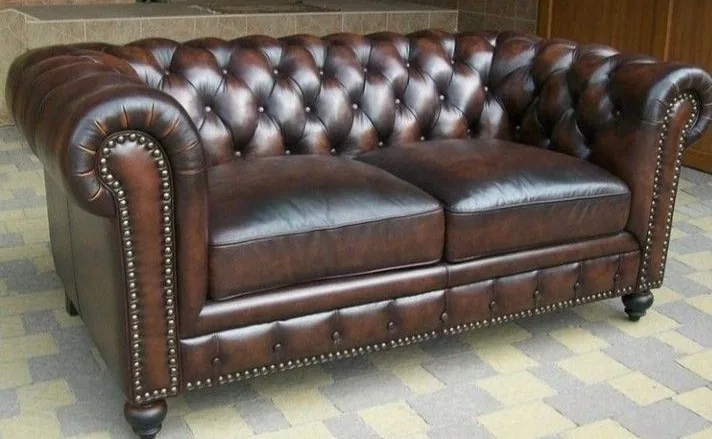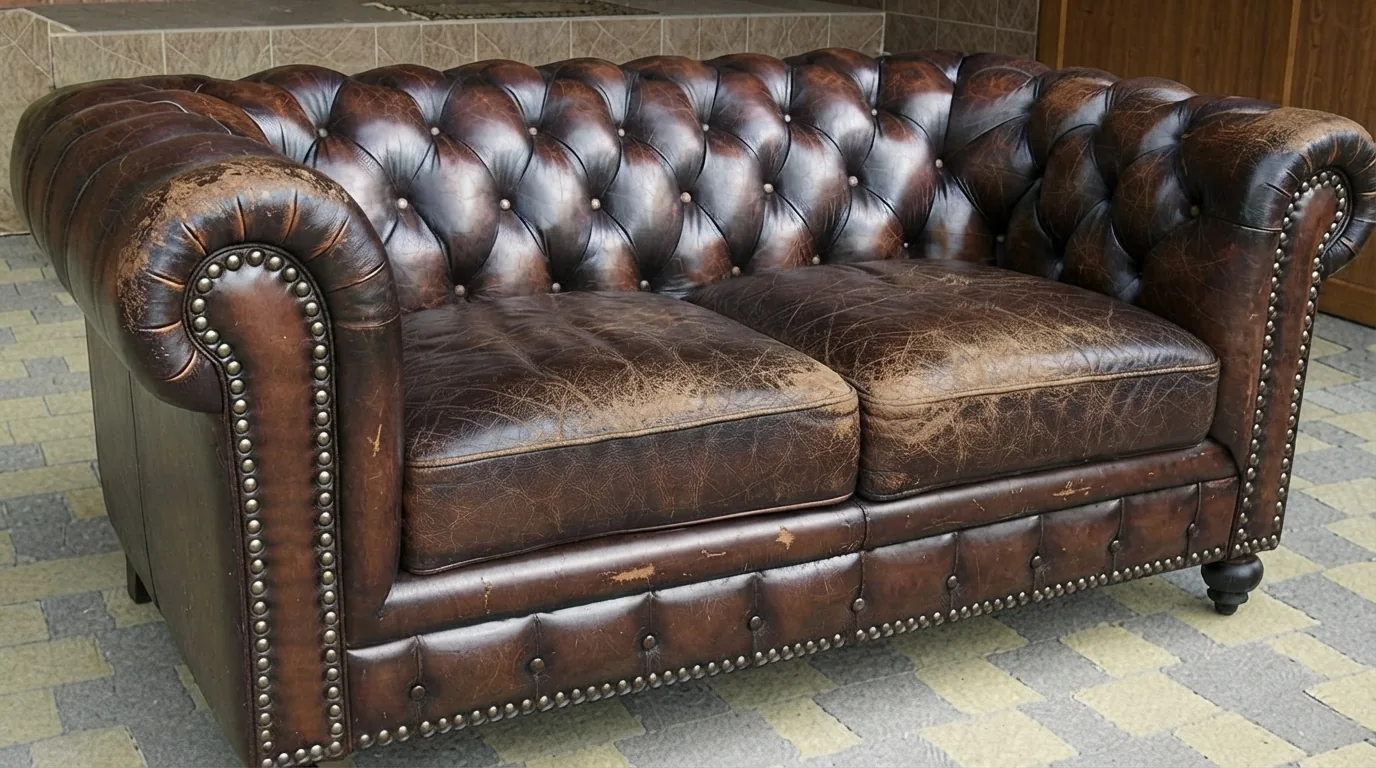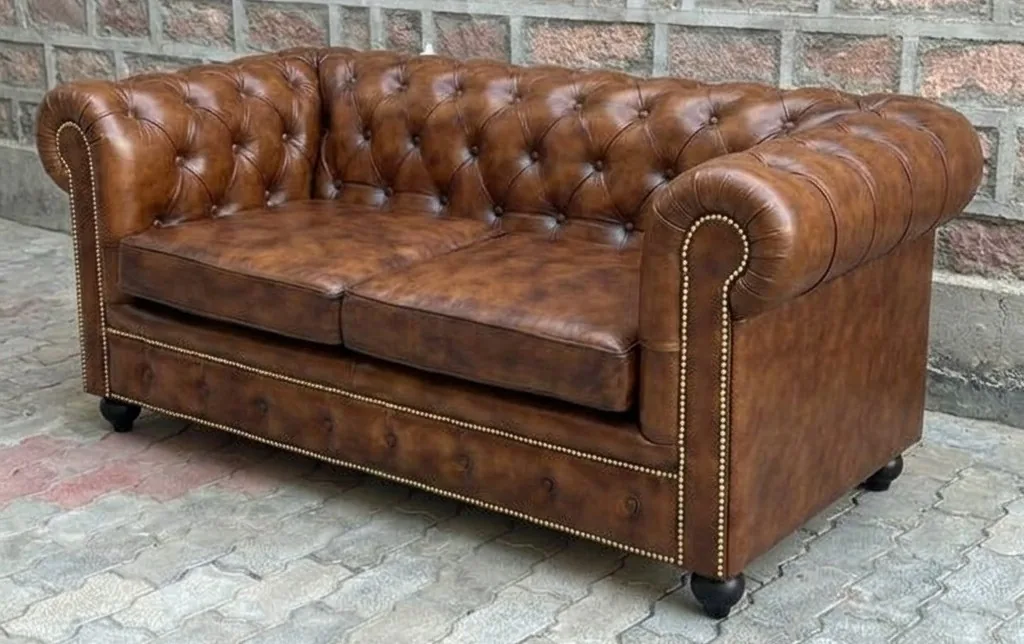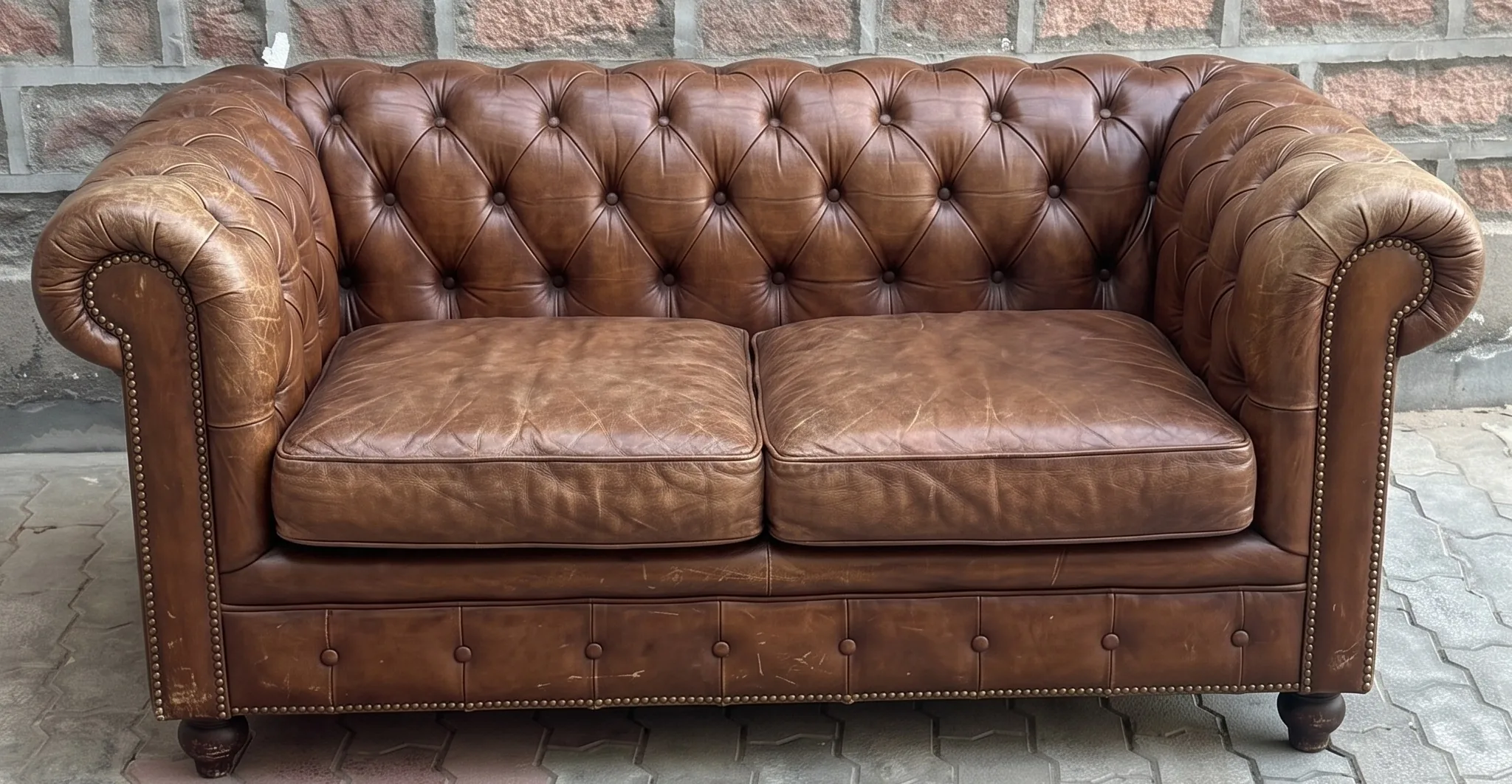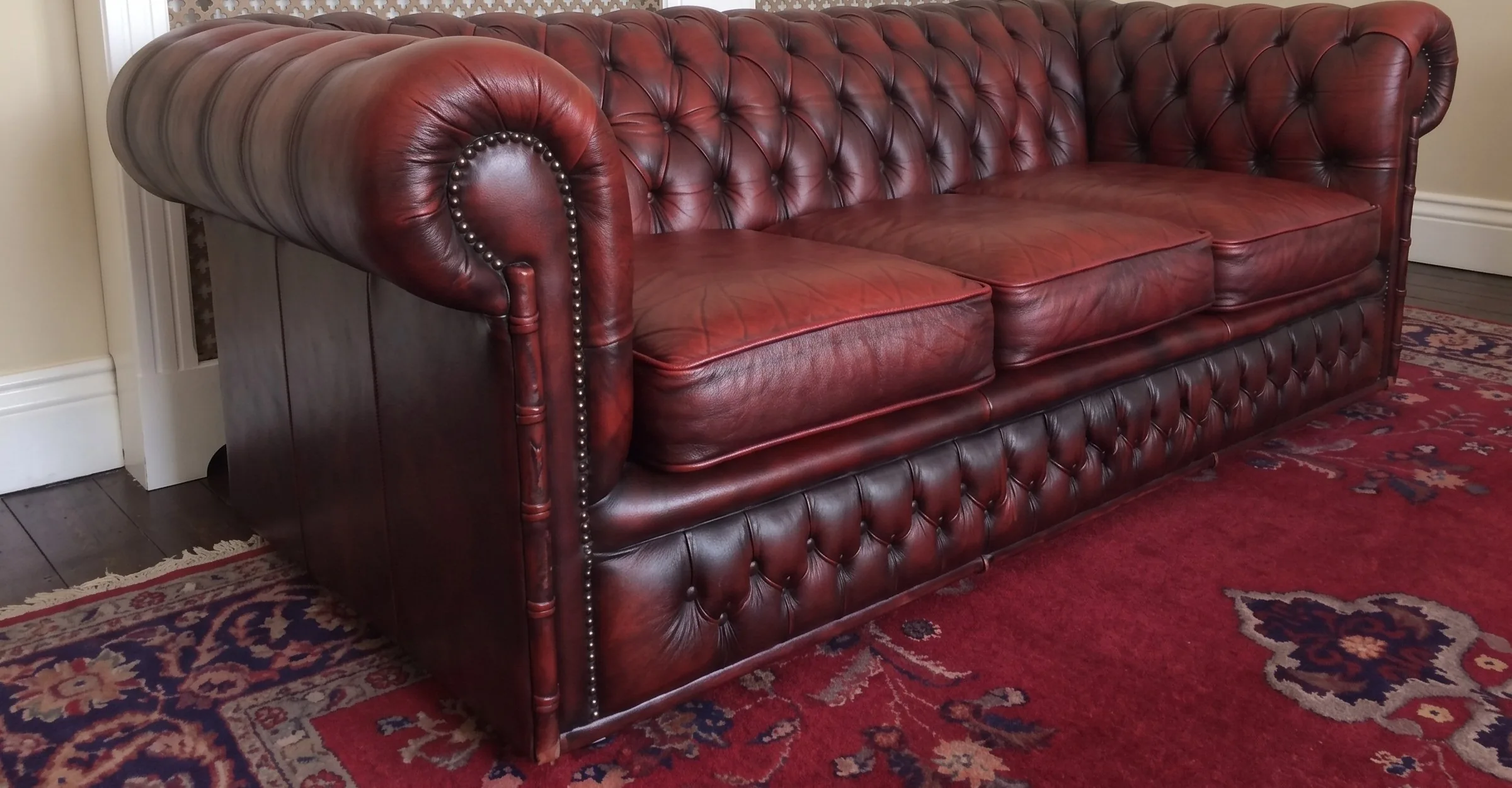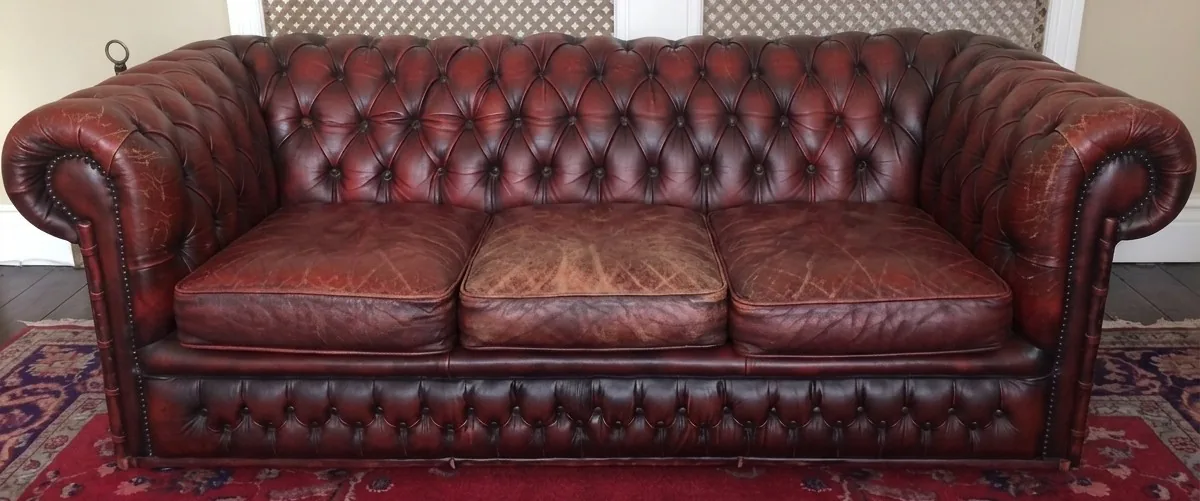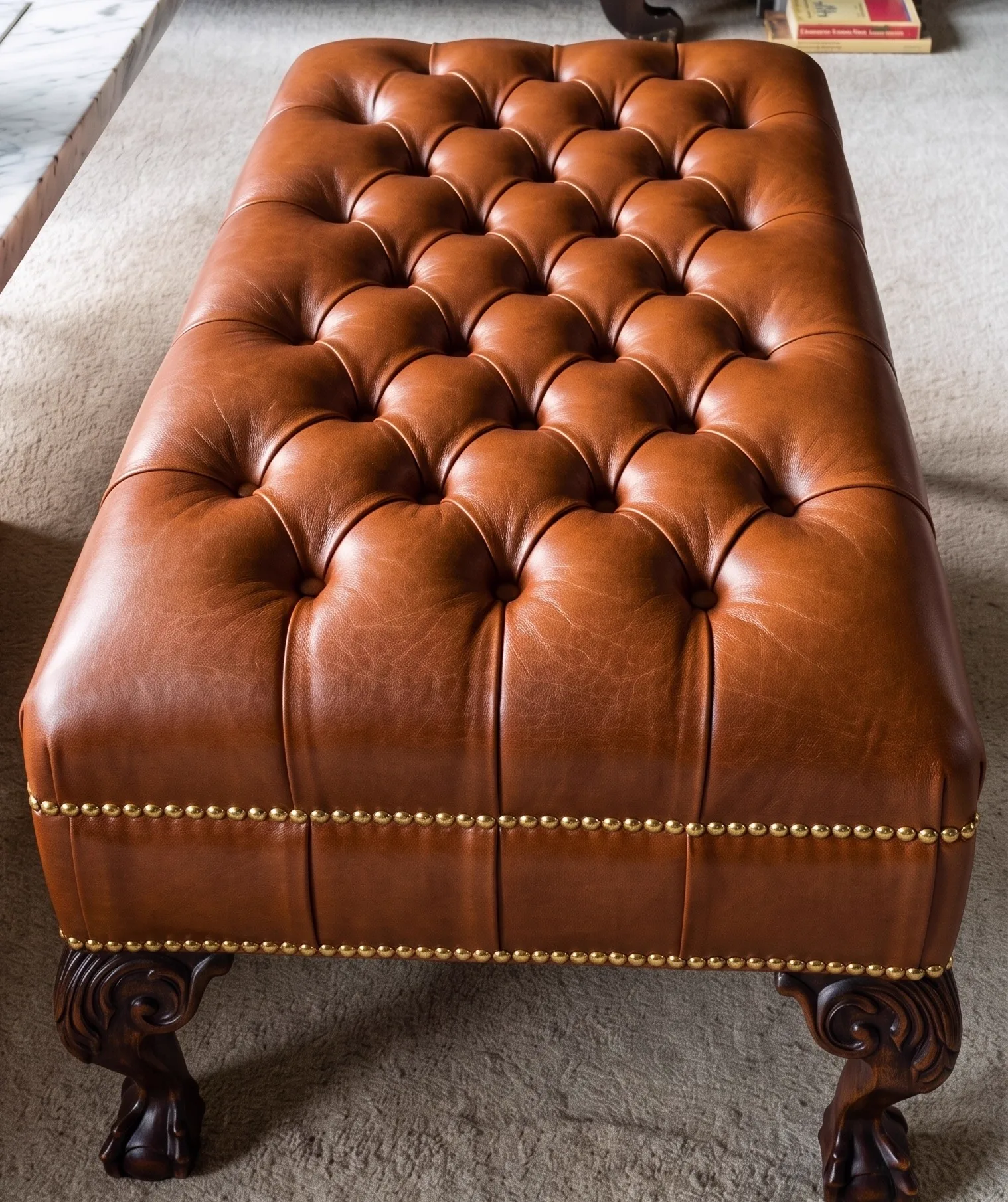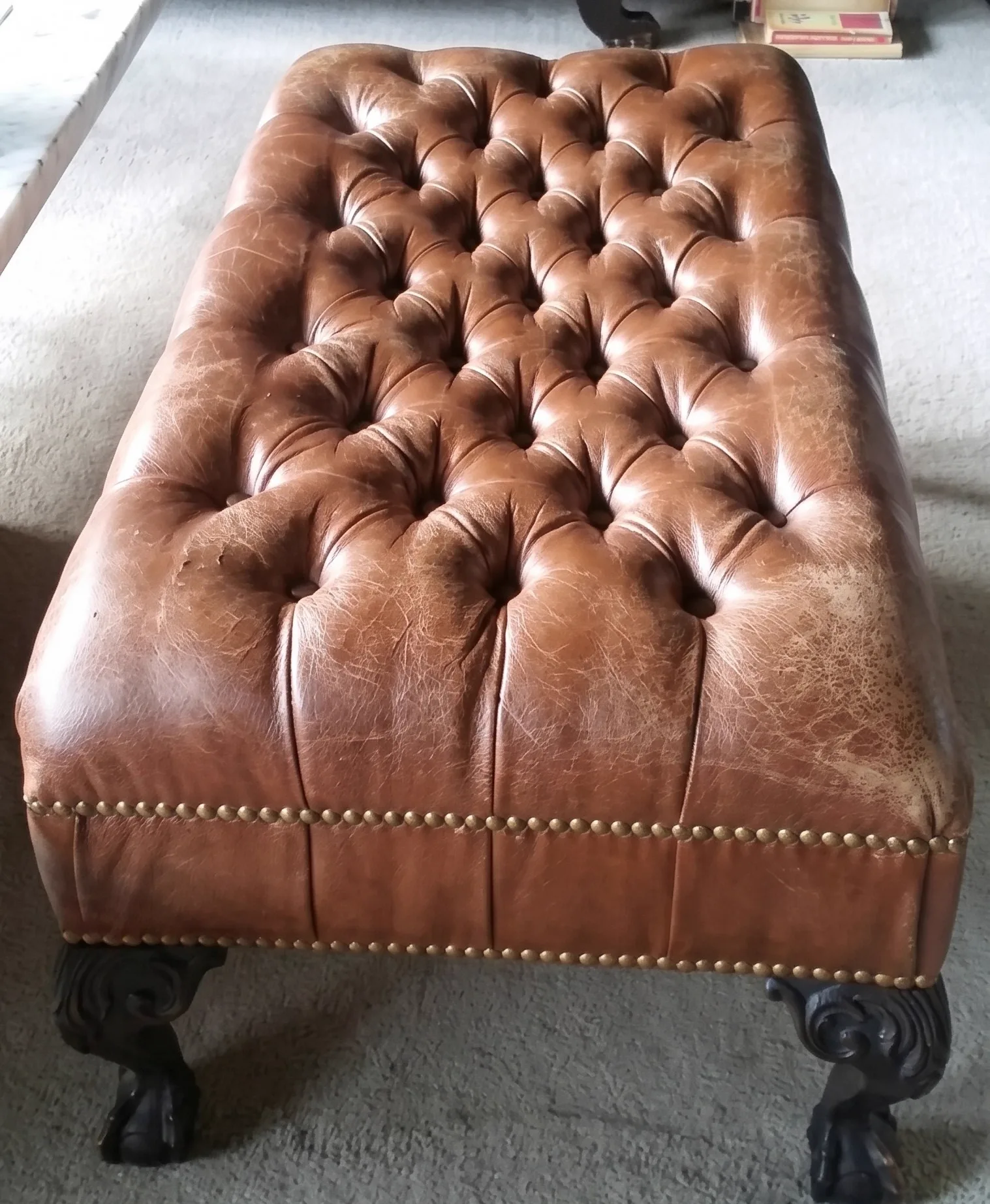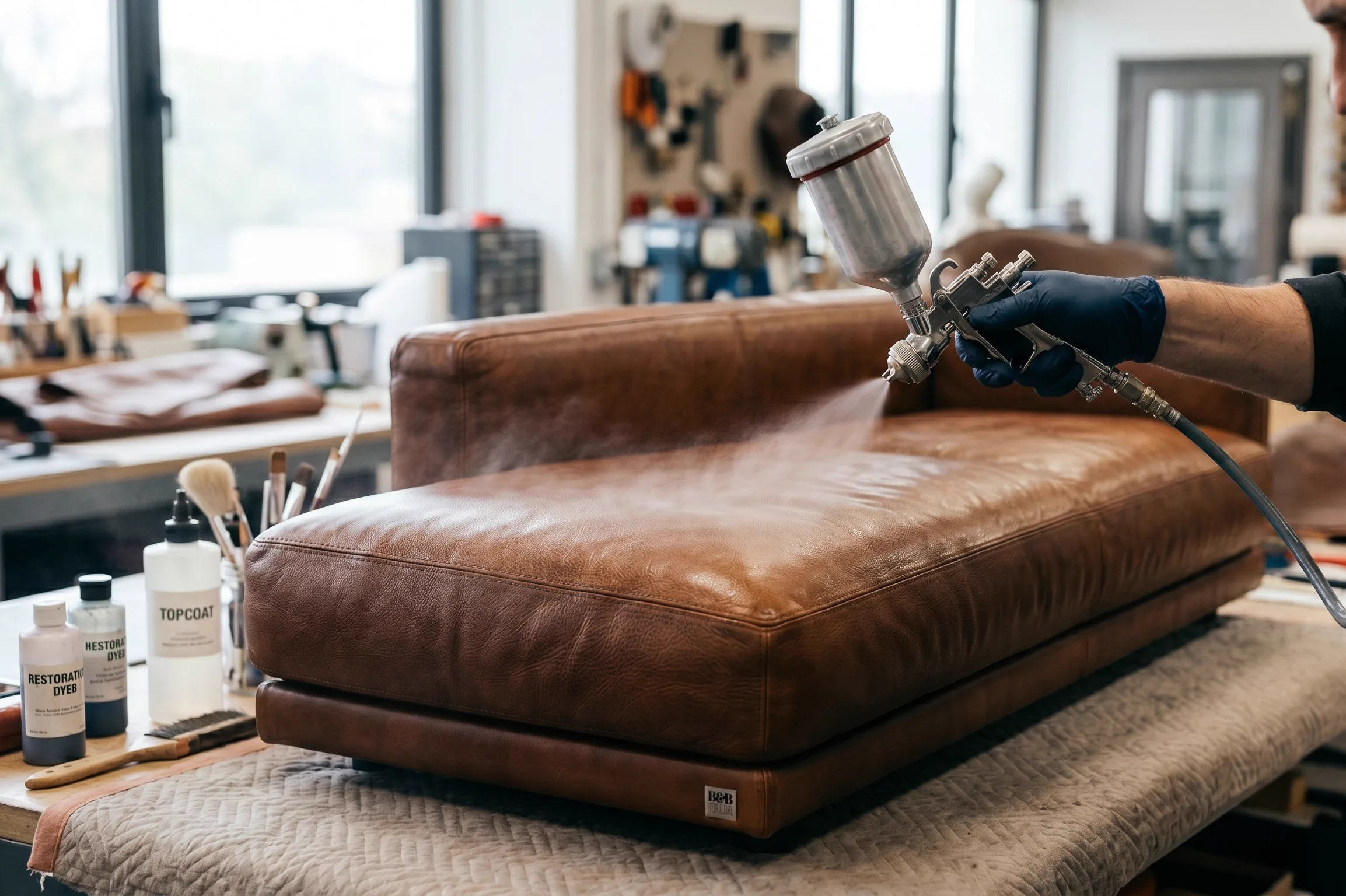
If your Chesterfield has been in the family for twenty years, it is probably showing it. The leather has faded unevenly. The tufts feel looser than they used to. The contact zones are darker and slick. This is Project 001 , the first case study in our documented restoration archive. The piece is a 20-year-old hand-buttoned three-seater Chesterfield in vegetable-tanned full-grain leather. It was commissioned for a Lutyens-zone bungalow in central Delhi and brought to us for expert repair ahead of entry into the family's heirloom protocol dossier. This case file follows the same format we use internally: diagnostic intake, twelve stages, panel-by-panel notes, and an outcome record. Chemistry references are linked throughout: tanning chemistry, fat liquor, pH balance, the science of moisturizing, and micro-pigmentation.
What Was the Sofa and How Was It Built?
The Chesterfield is a three-seater in classic English club construction. It has deep hand-buttoned diamond tufting on the seat-back and inside arms, a rolled-arm profile, and turned-mahogany legs. The frame is hand-jointed kiln-dried hardwood. The seat platform runs on eight-way hand-tied coil springs over jute webbing. The hide is a single tannery output of full-grain [leather where no surface layer has been removed] vegetable-tanned bovine leather in a classic mid-tone aniline [leather with no heavy surface coating] finish. Everything about this construction favours restoration over replacement: the frame is rebuildable, the spring system is replaceable, and the hide responds well to documented care across decades.
The sofa arrived with twenty years of NCR domestic use. The family brought the original commissioning record, which accompanied the intake. The intake interview established the use pattern: drawing-room placement, daily use, indirect window exposure on the south-facing wall, no prior professional repair, no care log. Over the years, household staff had wiped it down with what the family believed was a leather cleaner. On inspection it turned out to be a generic alkaline household product. What two decades of wrong-chemistry exposure does to leather is documented in our guide on pH balance and leather longevity and the warnings in household DIY damage.
The owner's brief was clear. The goal was not to make it look new. The goal was expert preservation of the sofa, restoration of the hide chemistry to a level that supports another generation of use, and a written record of the work suitable for the family's heirloom protocol.
The intake principle: the brief is set before the work begins. Restoration with a clear preservation brief produces different results than restoration aimed at new-condition appearance. The project file records the brief alongside the work.
What Did the Inspection Actually Find?
The diagnostic ran across three sessions on consecutive workshop days. Session one was visual: inspection under raking light [angled light that shows surface damage clearly] across every panel. Session two was chemistry: pH spot testing on representative panels, tannage confirmation, and fat-liquor [the oils built into leather during tanning] depletion estimate. Session three was structural: frame integrity, spring tension, webbing condition, and button-tuft anchoring across all forty-seven tufts.
The visual inspection identified four distinct condition zones. The seat-cushion contact panels showed measurable fade of roughly fifteen percent compared to the protected back panel. This is consistent with twenty years of indirect daylight and daily use. The inside-arm panels showed crocking [colour rubbing off onto contact surfaces] and pigment migration, with a ring of discoloured halo around the contact zone. The mechanism is documented in the dedicated guide on crocking and colour transfer. The button-tuft pockets had accumulated particulate [fine particles and debris] at depth that surface cleaning had never reached. The protected vertical back panel was the cleanest surface on the sofa , close to the original tannery output, and the reference for the pigmentation specification later.
The chemistry assessment confirmed full vegetable tannage on spot test. Surface pH read at 7.8 to 8.2 across multiple panels. That is meaningfully alkaline compared to the leather-safe band of pH 5.0 to 5.5 described in the pH balance guide. The drift matched two decades of repeated exposure to the alkaline household cleaner. Fat-liquor depletion was estimated as high. The surface drag on the inspection cloth, the loss of suppleness in the tufted zones, and the early micro-cracking on the highest-fade panels all pointed to a substantially depleted fat liquor reservoir. The full mechanism is in the fat liquor guide.
The structural assessment was more encouraging than the chemistry. The hardwood frame was tight at every joint. Spring tension had loosened slightly across the seat platform, but was within the range that responds to coil retensioning rather than full re-springing. The webbing was original and serviceable for at least another decade. Forty-three of forty-seven button tufts were sound. Three had loosened and one button was missing entirely. A hide-matched covered-button replacement was specified at intake.
What Happened in Each of the Twelve Stages?
We set the twelve-stage plan after the diagnostic and reviewed it with the owner before starting any work. Each stage has a specification, a duration, and a documented outcome that goes into the project file. The full process ran across twenty-one working days.
Stage 01 , Documentation intake
We opened the project file and ran a provenance review with the owner. We took macro photos of every panel against a fixed colour reference card under standardised lighting. We drew a panel-reference map for the sofa. This map guides every subsequent stage and forms the spatial reference for the protocol log. Duration: half a workshop day.
Stage 02 , Diagnostic assessment
Three-session diagnostic across consecutive days, as described above. Findings went into the project file and were reviewed against the brief before we started any repair work. The diagnostic record is the first structured entry in the long-term heirloom protocol dossier for the sofa.
Stage 03 , Deep-pore extraction
We applied an anionic dispersant across the full hide under controlled dwell time, then extracted it immediately. This lifted twenty years of accumulated atmospheric particulate, body oil, and household-cleaner residue from the grain layer and button-tuft pockets , without stripping the underlying tannage. The colour shift on the extraction cloth at this stage was visible and significant. The surface had been carrying soiling that no surface-cleaning approach would have reached.
Stage 04 , pH-neutral cleaning pass
We cleaned the full hide with a pH-neutral cleaner held at pH 5.0 ± 0.5. Two passes on contact-zone panels , seat cushions, inside arms, and the highest-use back panel. One pass on protected panels. The goal of this step was to lift the alkaline residue from two decades of wrong-product use and bring the surface chemistry back into the range that re-fatliquoring requires. Surface pH after the pass measured at 5.4 to 5.6 , within the leather-safe band in the pH balance guide.
Stage 05 , Fibre stabilisation
We targeted the inside-arm contact zones where micro-cracking had started in the grain layer. Stabilisation stops crack propagation before re-fatliquoring penetrates and before pigmentation rebuilds the surface. The mechanism , and the longer-term fibre delamination that this step prevents , is in the fat liquor guide. Duration: one full workshop day.
Stage 06 , Crust re-fatliquoring
A vegetable-tannage-matched conditioning emulsion penetrated the corium [the lower layer of the hide] across three controlled application sessions over six workshop days. The conditioning interval and dwell time between applications are set against the depletion estimate from the diagnostic. Heavily depleted hides need multiple shorter applications , not a single saturating pass. The mechanism is in the science of moisturizing.
The hide responded visibly at each application. Surface drag reduced after the first pass. Suppleness returned to the tufted zones after the second. The fat-liquor reservoir was rebuilt to the correct level by the third. Re-fatliquoring is the single biggest contributor to how long the repair lasts. A sofa that is cleaned and pigmented without proper re-fatliquoring comes back to the workshop within five years.
Stage 07 , Panel-level fade documentation
We used a spectrophotometer to map every panel against the protected vertical back panel as the colour reference. Fade direction and depth were recorded panel by panel against the panel-reference map. This drove the pigmentation specification for stage eight. The seat panels needed the deepest pigmentation pass. The inside arms needed pigmentation plus crocking-zone correction. The protected panels needed only the sealing top-coat in stage nine.
Stage 08 , Micro-pigmentation
We matched colour to the original tannery output by airbrushing in translucent layers. The goal was not to repaint the hide. The goal was to rebuild the pigmentation lost to fade and crocking while keeping the aniline character of the original finish intact. The full mechanism , and the difference between micro-pigmentation and overpainting , is in the micro-pigmentation process guide. Duration: two workshop days. Verification under raking light at the end of each day before moving on.
Stage 09 , Top-coat lamination
We applied an acrylic top-coat [the clear surface layer that protects the pigmentation] at controlled film thickness across the full hide. This locks the pigmentation in place, re-establishes the original wear surface, and gives the re-fatliquor reservoir the layer it cures into. Film thickness was matched to the original aniline character. Too heavy a coat would have shifted the finish toward semi-aniline , outside the brief. The framework for identifying and preserving finish type is in the guide on aniline, semi-aniline, and pigmented finishes.
Stage 10 , Button-tuft reconstruction
Three loose tufts were re-anchored through the seat platform with hand-tied thread to the underlying webbing. One missing button was replaced with a hide-matched covered button, hand-cut from the same hide stock used at the original commissioning. The family had kept off-cut stock from the 2006 build, which allowed an exact match. Tuft tension was set to match the existing forty-three sound tufts across the sofa.
Stage 11 , Final conditioning and cure
We applied a final conditioning pass across the full hide, then held the sofa in our environment-controlled cure room for seventy-two hours before handling it for outcome documentation. The cure window is non-negotiable. Moving the sofa before the top-coat and final conditioning have stabilised leaves handling marks that compromise the documented outcome.
Stage 12 , Outcome documentation
We took macro photos of every panel against the same colour reference card used at intake, under the same standardised lighting. The outcome record was paired with the baseline record in the project file. Spectrophotometer verification on a sample of contact-zone panels confirmed the pigmentation match held against the protected reference panel. The protocol log was finalised, printed on archival paper, and prepared for handover with the sofa.
"The protocol log is the deliverable. The restored sofa is the surface evidence of the work. The project file is the document that travels with the sofa into the next generation."
What Does the Project File Contain After the Work Is Done?
The completed project file handed back with the sofa holds the full record of the work. It contains: the provenance review and intake interview from stage one; the three-session diagnostic with chemistry readings, structural notes, and visual inspection findings under raking light; the baseline macro photography series and panel-reference map; the stage-by-stage repair log with chemistry specifications, application schedules, dwell times, and master restorator notes; the spectrophotometer fade map and pigmentation specification; the outcome macro photography paired against the baseline; and the final protocol log printed on acid-free archival paper for the family's heirloom dossier.
The sofa returned to the family residence with an ongoing care plan. Quarterly visual checks under raking light by trained household staff, with notes against the panel-reference map. Annual macro photography against the colour reference card retained from the project. A bi-annual in-person inspection by the master restorator. The conditioning interval was set at twenty-four months for the first revisit, to be adjusted at that point based on observed condition. The full framework is in the companion guide on museum-grade leather maintenance.
The cost of restoration was a small fraction of replacing the sofa with a new commissioned equivalent. More importantly, the restoration preserved the original construction, the original hide chemistry, the original button-tuft work, and the family's twenty-year history with the piece. None of that is recoverable through replacement.
Why This Project Sets the Standard for All Our Work
Project 001 sets the working method for every project that follows. Thorough documentation at intake. A three-session diagnostic before any chemistry touches the hide. Twelve stages, each with a specification, duration, and outcome. Macro photography baseline and outcome paired in the file. Protocol log printed on archival paper and handed back with the sofa. The repair brief written and recorded before the work begins.
This case study is published in full as the reference for our working method. Subsequent project files will follow the same format. The archive serves two purposes: a working record for the workshop, and a published reference that owners, restorators in training, and the heritage furniture community can read and hold us against. The framework is shared, not proprietary. The ten thousand hours of practice behind it is what sets the work apart.
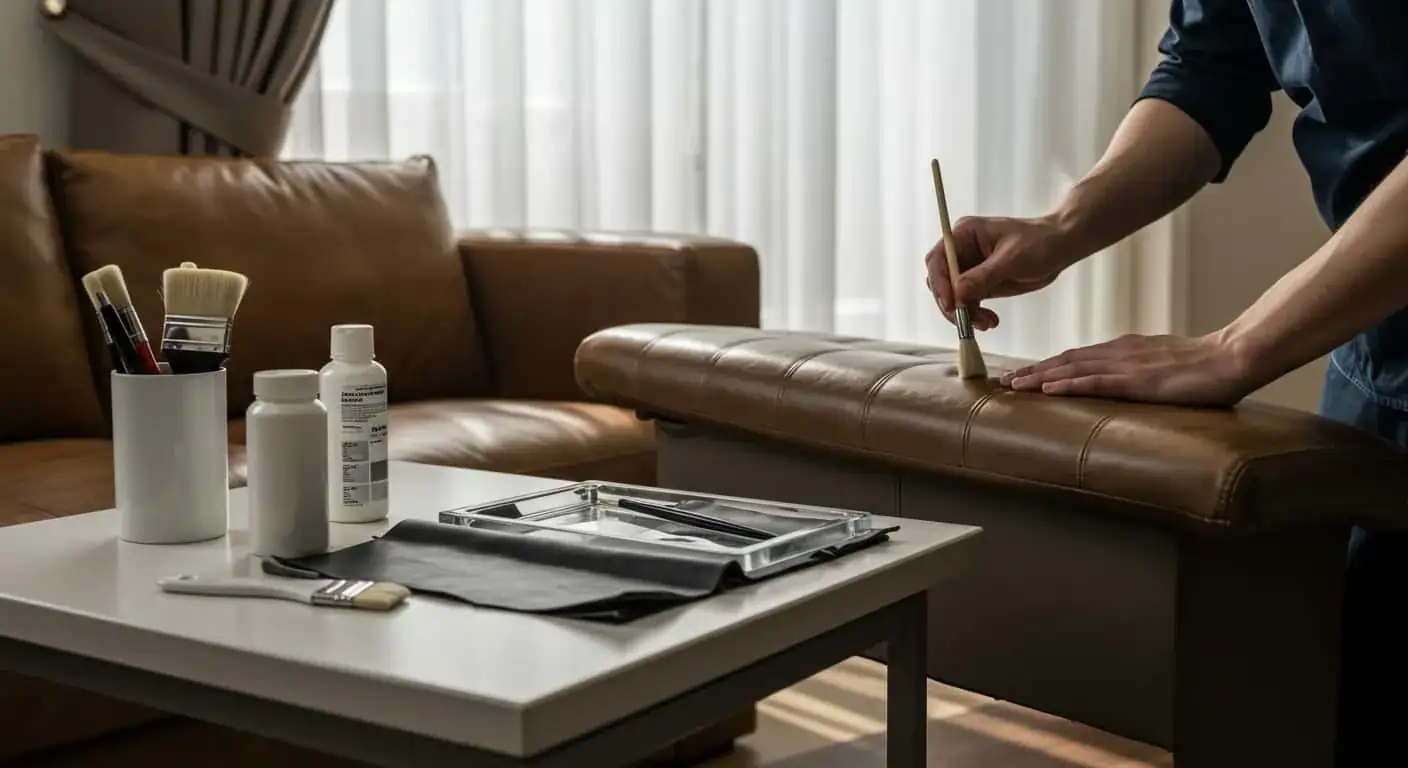
If you own a heritage Chesterfield, a vintage English club piece, or any hand-buttoned leather furniture in India, you can open a project file with us for Chesterfield restoration. We work across Delhi through sofa crack and tear repair, Gurugram through surface refinement, and across Noida, Faridabad, and Ghaziabad with doorstep intake. Every project starts the same way: provenance review, baseline macro photography, and the opening of the project file that becomes the protocol log you get back with your sofa.
Bookmark this page. The next time you want to know what expert Chesterfield restoration actually involves , what the twelve stages do, what the project file holds, and what the restored sofa looks like , this case study answers the question.